Disclaimer: this video/review was not sponsored by MING or any other entity.
Video
A Crowded Space Filled With Unoriginal Ideas
Over the last seven-ish years, integrated-bracelet watches have exploded in popularity, largely driven by the hype around two pieces: the Patek Philippe Nautilus and the Audemars Piguet Royal Oak. As a community, we gaslit ourselves into believing that these were the epitome of watch design. Demand went through the roof, secondary prices became astronomical, and suddenly every brand and their uncle either rushed to launch an integrated-bracelet watch or revived one that had been rotting in the back catalog for decades.
Having handled both the Nautilus and the Royal Oak extensively, I’ll say I understand a lot of the appeal. At least in their best references, they feel genuinely well-considered, with bracelets that are legitimately excellent and a cohesive design story that ties the whole watch together.
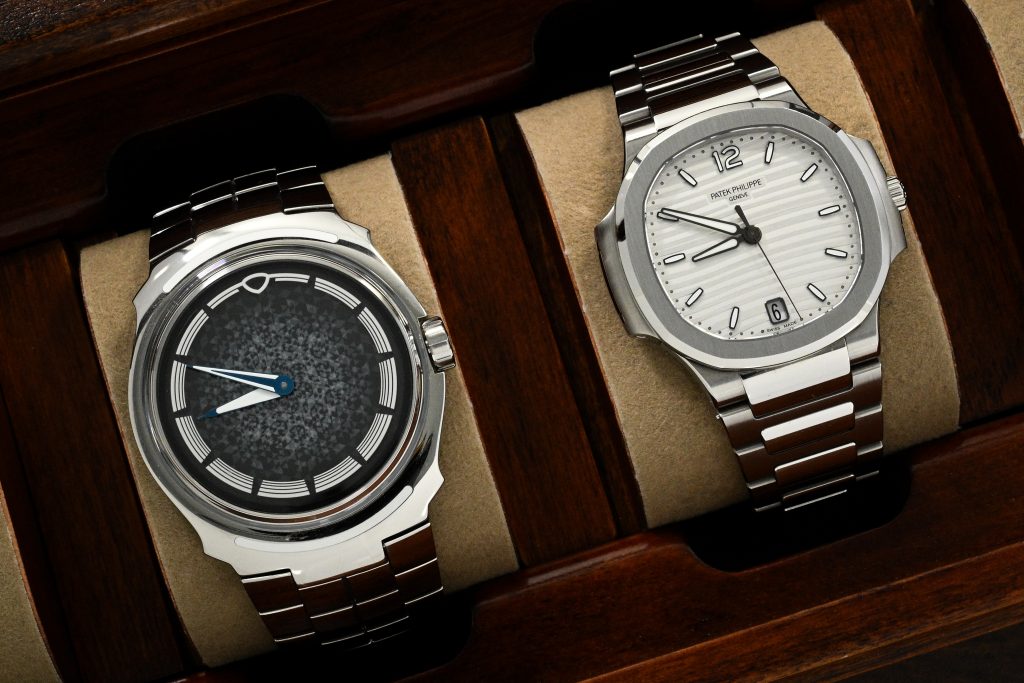
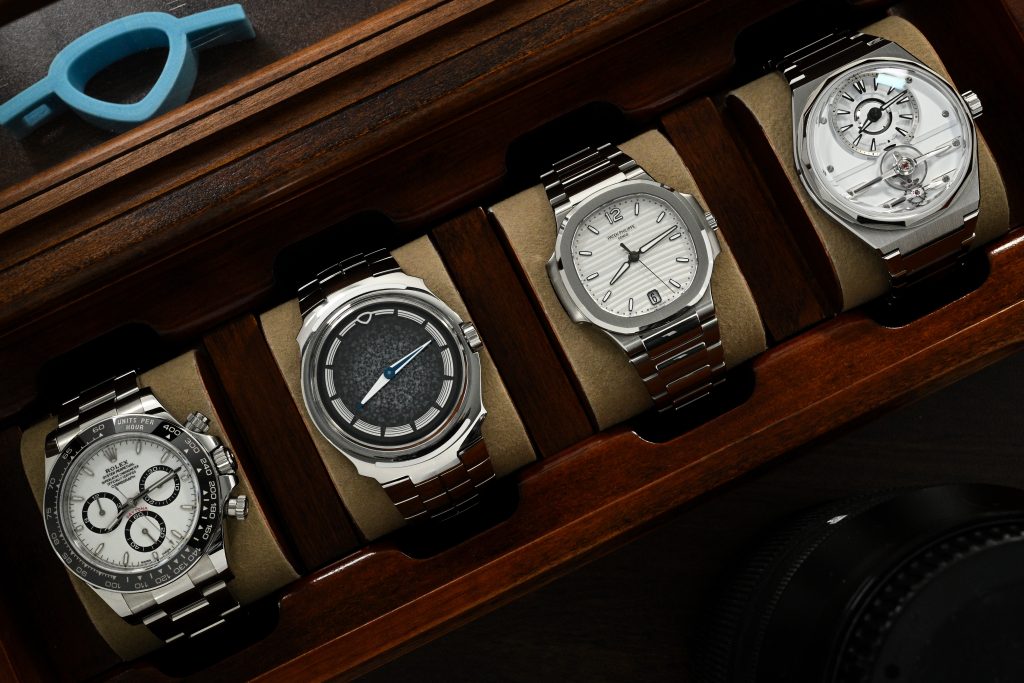
But where we are today is a crowded, messy category with options across the entire price spectrum: from Tissot’s PRX line, to Christopher Ward’s Twelve, to the IWC Ingenieur (which does have historic precedence, but also joined the party much later than it should have), and then the more rarefied stuff like the Credor’s Locomotive, Czapek Antarctique, Moser Streamliner, Romain Gauthier C, Armin Strom One Week, and so on. Some of these watches embody the philosophy of building a fully integrated, memorable product with its own design language, but most are forgettable improvisations on a heavily recycled theme.
And in the rush to get a product to market, plenty of brands put out half-baked watches meant more to ride the hype wave than deliver something great. The bracelet details often gave it away: the majority of the watches I mentioned lacked micro-adjustments (Tissot PRX, Christopher Ward… initially), many lacked half links, a few tried to catch up by including extra accessories after the fact (Moser Streamliner, IWC), and some took a few years to even get the fit and feel of their bracelets right (Czapek).
But we’re on the other side of the hype wave now, and hopefully we can all see things more clearly. Hopefully we’ve learned to ask more from our hype watches and accept quality over status. We have, right? ….right?
Well, all of this is to say the integrated-bracelet world is largely fueled by the worst aspects of the hobby, with half-baked ideas hitting the market where the primary objective is generating shareholder value, then resale value and then maybe being a good watch. Which is why I’m glad MING didn’t rush to meet the hype cycle. As we’ll soon see, they took their time to do this properly and deliver a product that wouldn’t leave the buyer wanting more, at least where the fundamentals are concerned. The MING 56.00 Starfield was a small Special Projects Cave release, made in 20 pieces and priced at 19,500 CHF, or a staggering $25,000 at the time of writing, excluding tariffs.
Ming Thein & Rethinking Watch Design
So how does a brand whose entire claim to fame is being recognizable, unique, and creatively unhinged take on a genre that’s inherently constrained and, in many ways, creatively inhibiting? Over the last eight years, MING has shipped almost 80 references, and the remarkable part isn’t just the volume, it’s how often they managed to make each release feel like it had a point of view. Unique, forward–thinking, sometimes borderline insane, and only occasionally repetitive. And somehow, they’ve pulled that off while keeping the fundamental DNA consistent enough that you can usually spot a MING from across the room.
That consistency is impressive because MING has never been a one-trick brand, even though that’s what the ignorant tend to accuse them of. If you thought MING was “the lume brand”, the 27.01 and Project 21 were pretty effective reminders that it’s not that simple. If you thought a MING needed hands of a certain style to look correct, the LW.01 exists as a counterpoint. The details change, sometimes dramatically, but the watches still read unmistakably MING.
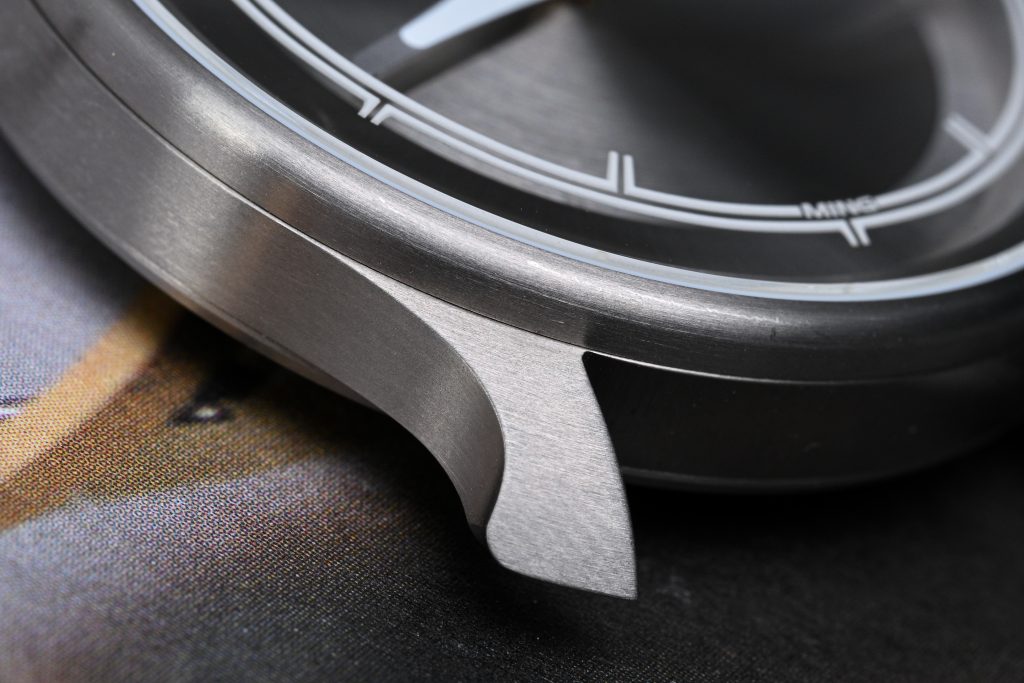
A lot of that comes down to a handful of design pillars that show up again and again: those flared lugs and compact lug-to-lug distances, the obsession with transparency and reflectivity, the use of exotic optical materials to create depth, and the recurring idea of a circular marker ring that functions as both an abstract, futuristic design element and a genuinely legible, timekeeping-critical structure.
And that’s exactly where the integrated-bracelet genre becomes a problem. Some of MING’s strongest signatures, especially the lug architecture and the way their cases “frame” the dial, don’t translate cleanly to a lug-less, bracelet-integrated form. The genre forces different proportions, different transitions, and a different set of priorities. Which means if MING was going to do this at all, they’d have to do something they don’t often have to do: compromise on familiar shapes without compromising on identity.
What Is An Integrated MING?
In a way, this isn’t the first “integrated” bracelet MING watch since they’ve flirted with fitted options before. But for most of the brand’s life, the dominant idea has been the Universal Bracelet: one bracelet designed to work across a huge swath of the lineup, rather than being engineered case-by-case. And more recently, MING took the concept of “we can do bracelets too” and dialed it to eleven with the Polymesh, a completely different kind of wearable object, realized via additive manufacturing in laser sintered Grade 5 titanium.
Having owned and reviewed at least three dozen MING watches over the last six years, I’ll say the Universal Bracelet has been a genuinely good solution on some models, and less so on others. But as MING’s prices climbed and certain case designs started to repeat, I won’t pretend I didn’t occasionally wish for something more purpose-built. The Universal Bracelets, now priced roughly between 650 CHF and 950 CHF, also came with some limitations, like no on-the-fly adjustability, and not much variety in finishing styles.
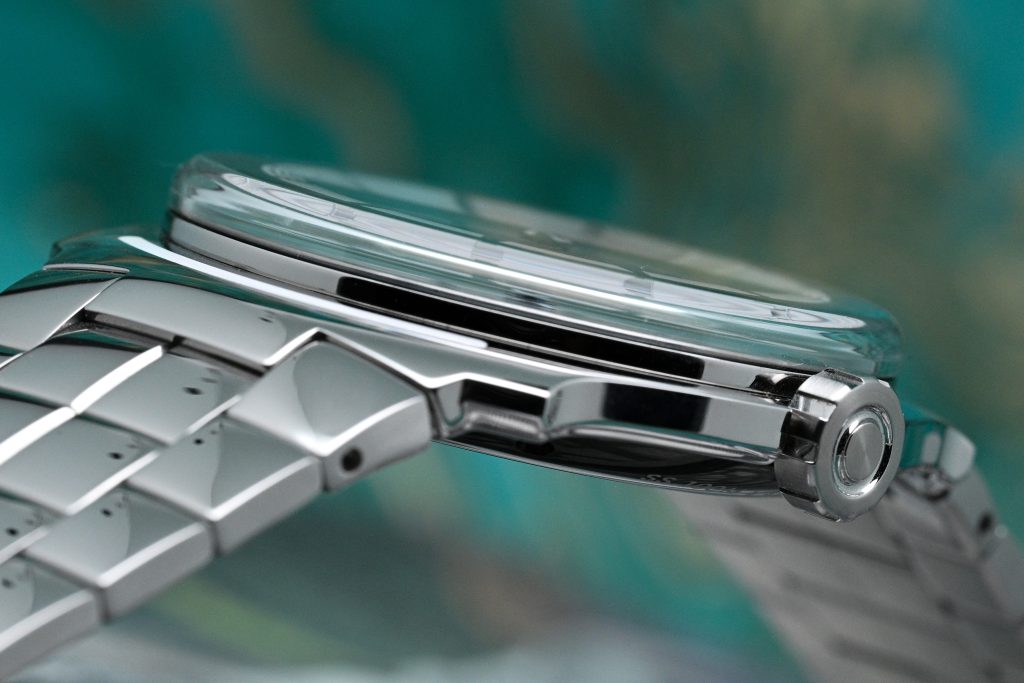
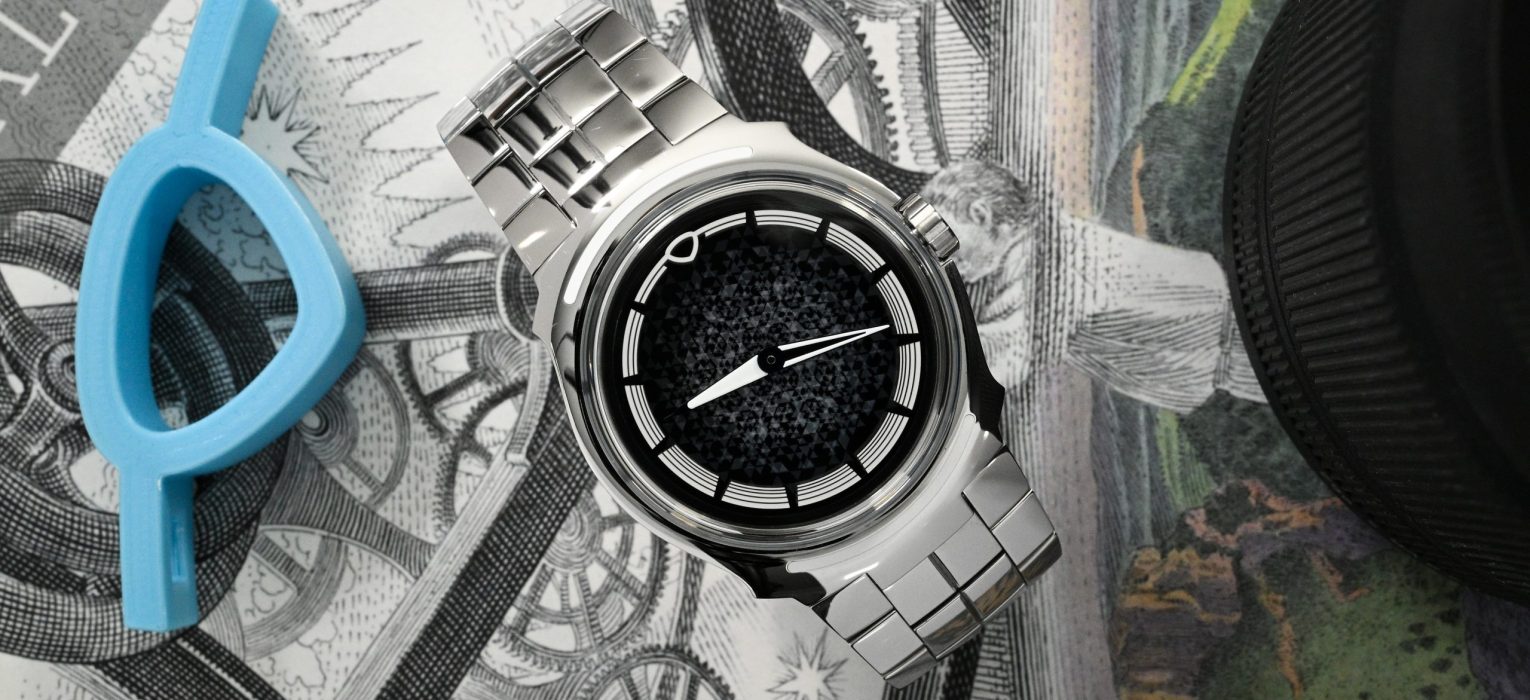
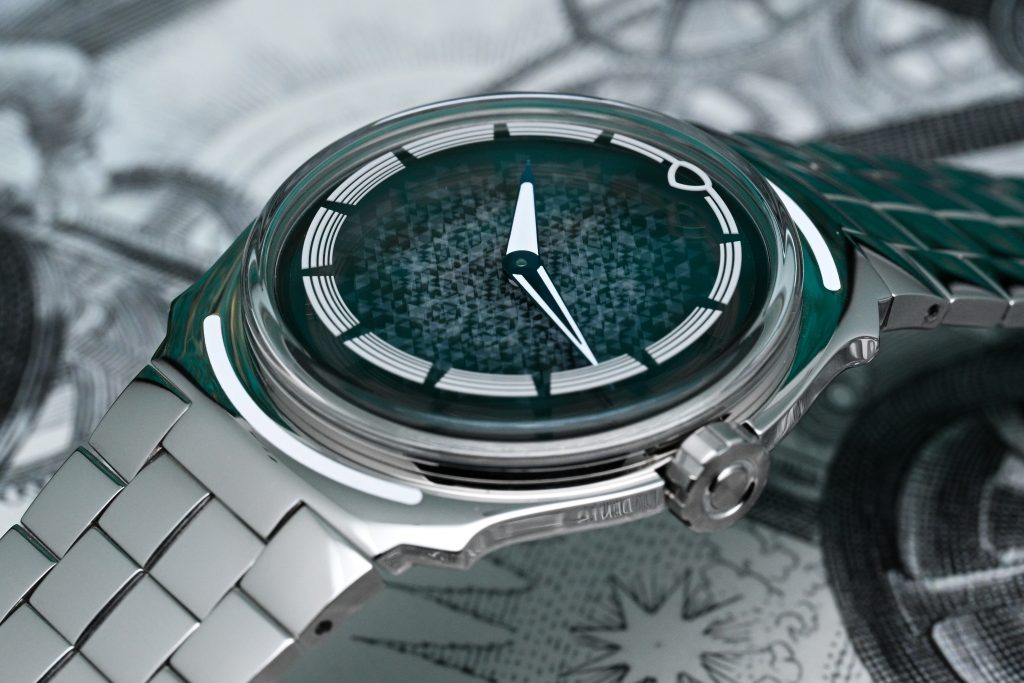
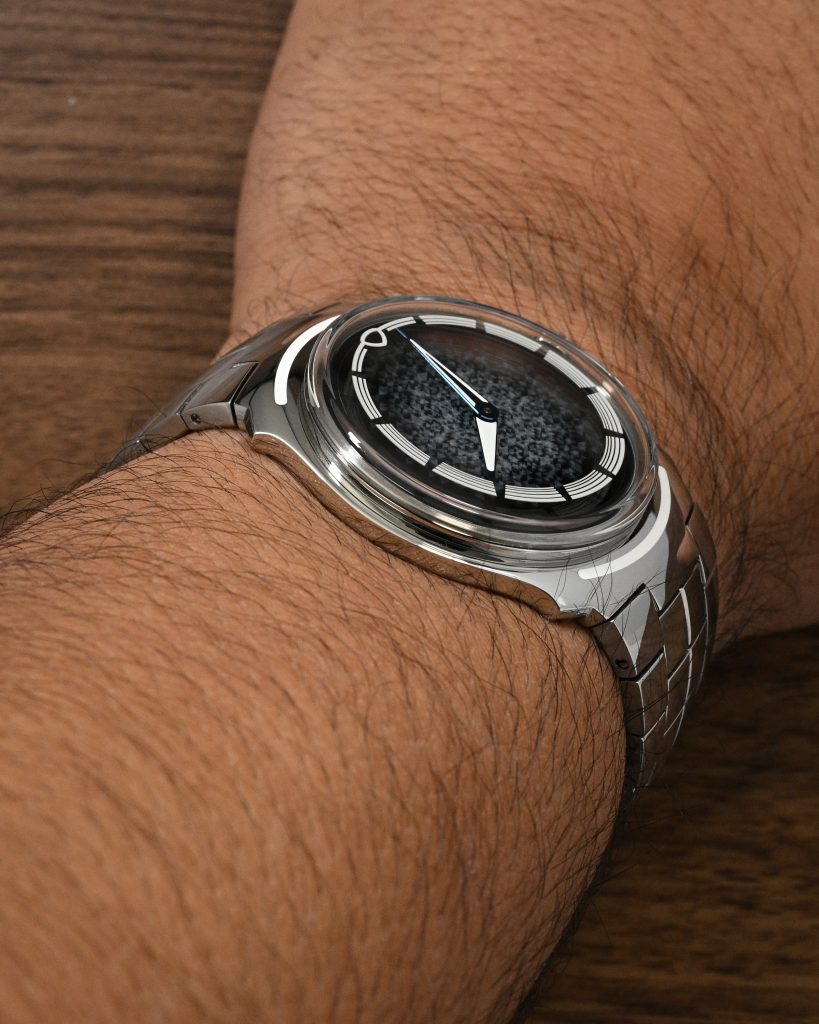
So the Starfield feels like MING embracing the idea of a fully integrated watch design again: if the bracelet is the watch, then it can’t be a universal accessory: it has to be part of the design spec from the first sketch. And that’s where the Starfield gets interesting, because MING didn’t translate their usual lug architecture into this format. The brand’s signature flared lugs are basically incompatible with the integrated-bracelet silhouette. Instead, the Starfield is built as a single flowing object: a 40mm, 9.7mm-thick case in mirror polished 316L steel, with a 6.75mm push-pull crown, boxed sapphire on top and 100 meters of water resistance, and weighs in at 120g sized for my 6.75″ wrist.
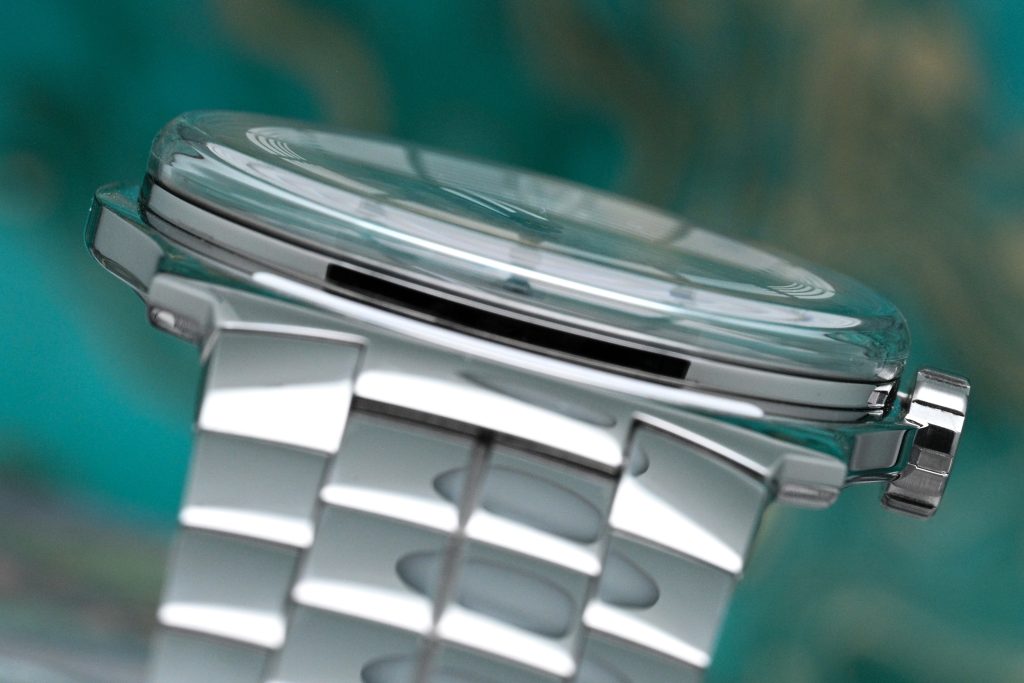
That all-polished decision is an interesting one though – it’s not the practical, brushed-tool-watch approach, it’s the “light is a design material”, and we’re going to show it off. And rather than relying on lugs for identity, MING threads in one of their more recent signatures: a subtle HyCeram luminous insert embedded into the case flanks, which is a structural design element that visually tries to wrangle the curved lug silhouette you’re expecting into this singular integrated unit.
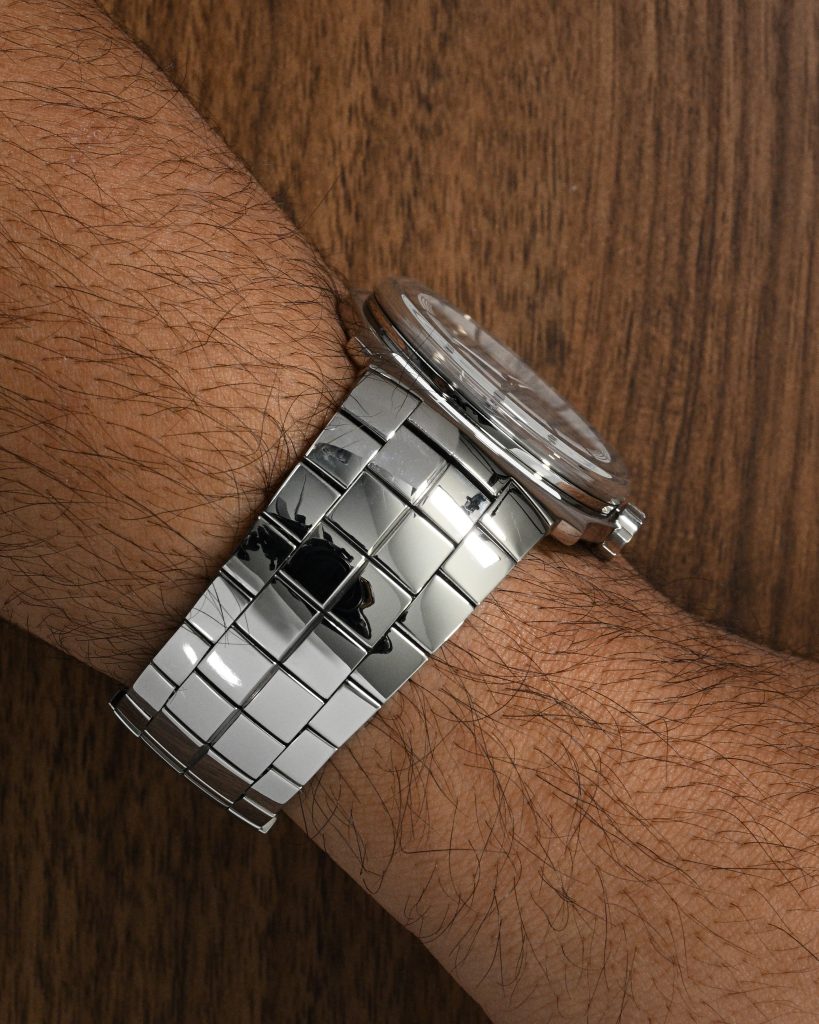
Then there’s the bracelet, and this is where MING clearly decided they weren’t going to ship a “version one” product and patch it later. The Starfield’s integrated bracelet comes with a patent-pending tool-less sizing system: each removable link has a slider on the underside that lets you detach it without tools. And instead of asking you to play the usual integrated-bracelet game of half links, MING built a toolless micro-adjust into their push-button clasp, offering 5mm total adjustment in 1.25mm increments, with 2.5mm available on either side. And if you’ve been following my reviews for a while, you’ll know how important this is to me. I will say that the extension breaks up the design quite a bit with a narrow protrusion that does wobble a bit, but I will gladly accept this for the functionality provided.
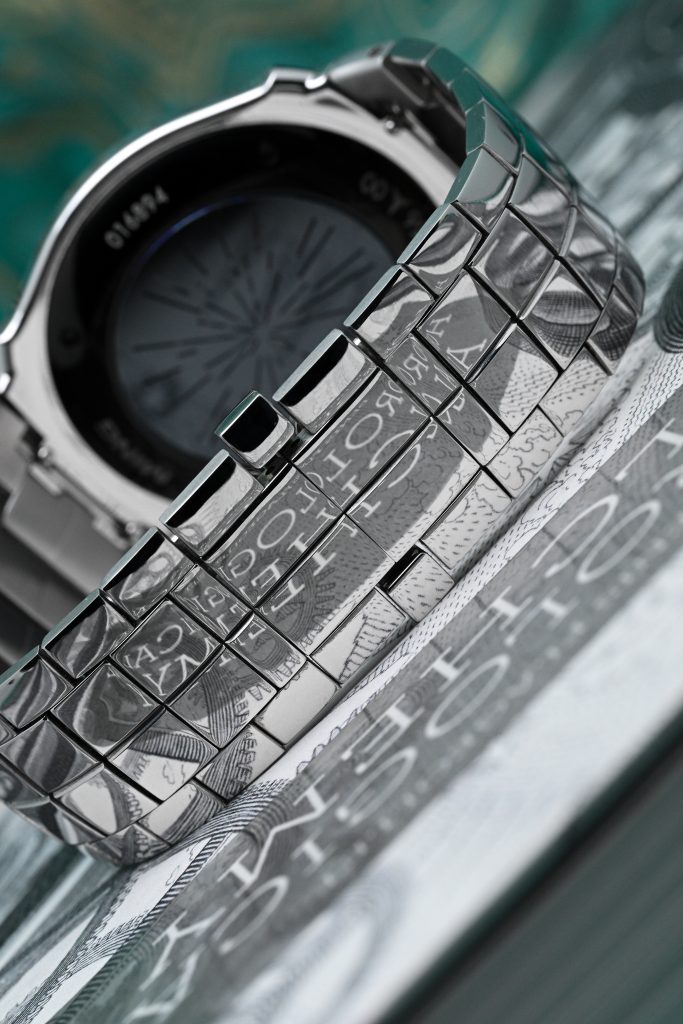
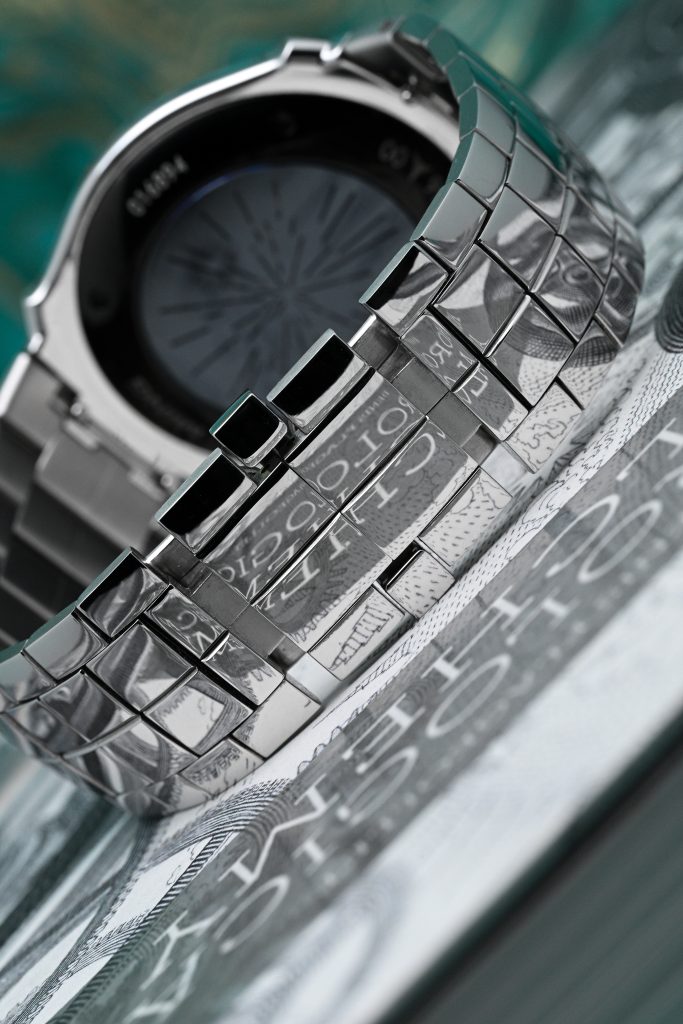
This is the point where the Starfield feels like MING treating the genre as a design problem worth solving properly. Because if integrated-bracelet watches live and die on comfort, fit, and how “complete” they feel as a single object, no compromises on functionality can be tolerated. And a key feature to the ergonomics are the links. They have a multi-axis construction, less like a flat chain and more like a series of curved shells designed to drape. According to Ming Thein, the trick to making a comfortable integrated design work is progressive curvature across multiple axes, curved links, and a higher pivot point. That geometry lets the bracelet conform smoothly to a wide range of wrist sizes without the usual integrated-bracelet problems: gaps at the case, awkward “hinge points”, or pinch points as it wraps around the wrist. The watch on bracelet has a maximum span of around 53.5mm, so you’ll need wrists at least 53.5mm wide to accommodate it comfortably. The bracelet tapers from about 24.75mm at the head to just under 20mm at the clasp.
Don’t forget the dial!
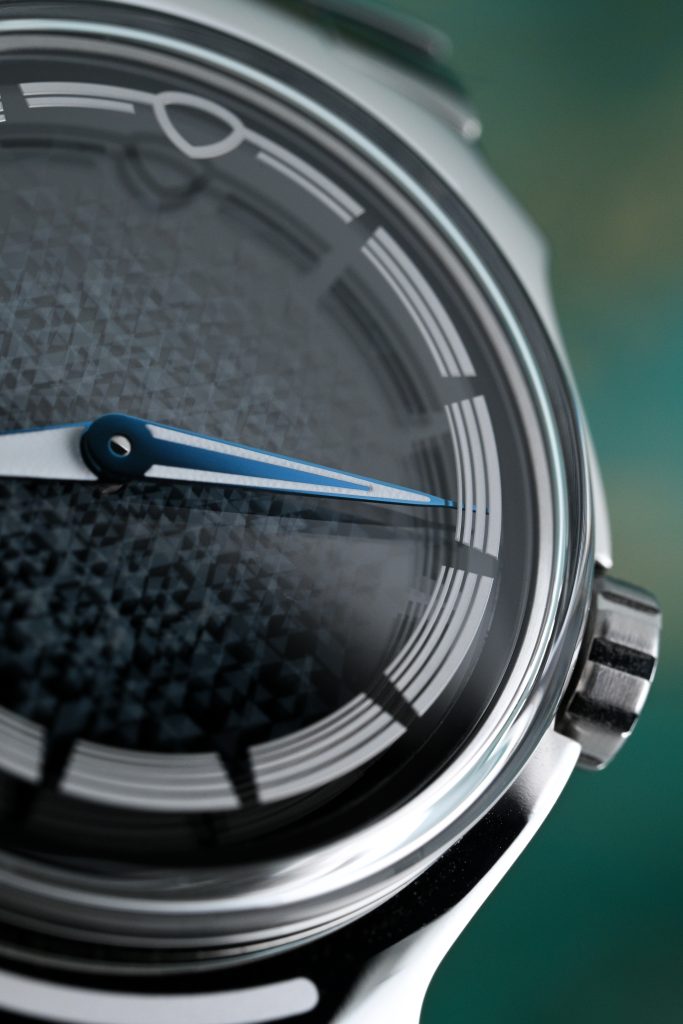
As with most MING watches, the crystal is part of the display system. The Starfield uses a beautiful boxed sapphire crystal with concentric ring segments engraved on the underside and filled with the brand’s Polar White lume. The engraving is intentionally asymmetric: the number of ring segments increases toward 6 o’clock, balanced by the logo at 12. These engraved sections floating over the dial create the familiar MING “floating” appearance which is always incredible to experience.
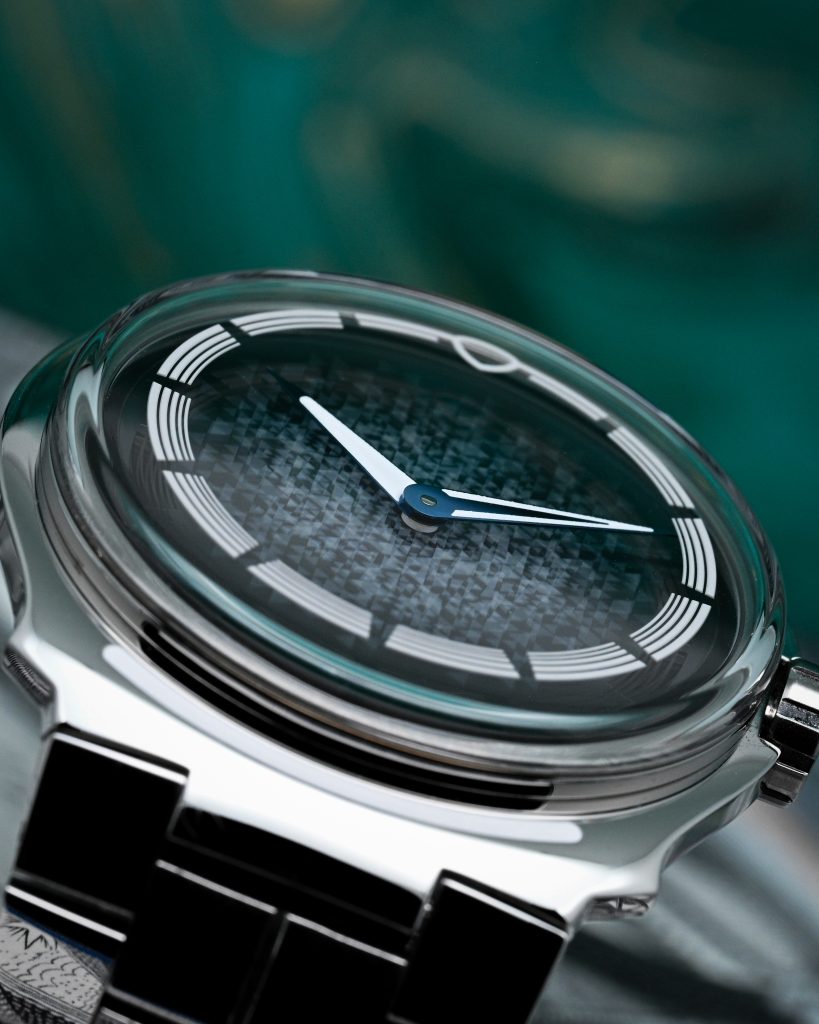
The dial itself is familiar MING territory: a sapphire Mosaic pattern laser-etched into different depths of a sapphire substrate using a femtolaser. We’ve seen this execution in pieces like the 20.11 Mosaic and 20.01 S2, and the Starfield’s pattern most closely resembles the more triangular geometry of the 20.01 S2. The hands are metallic blue and use blue-emission Super-LumiNova. The hour hand has a larger lume plot, while the minute hand uses a much slimmer, border-style lume application.
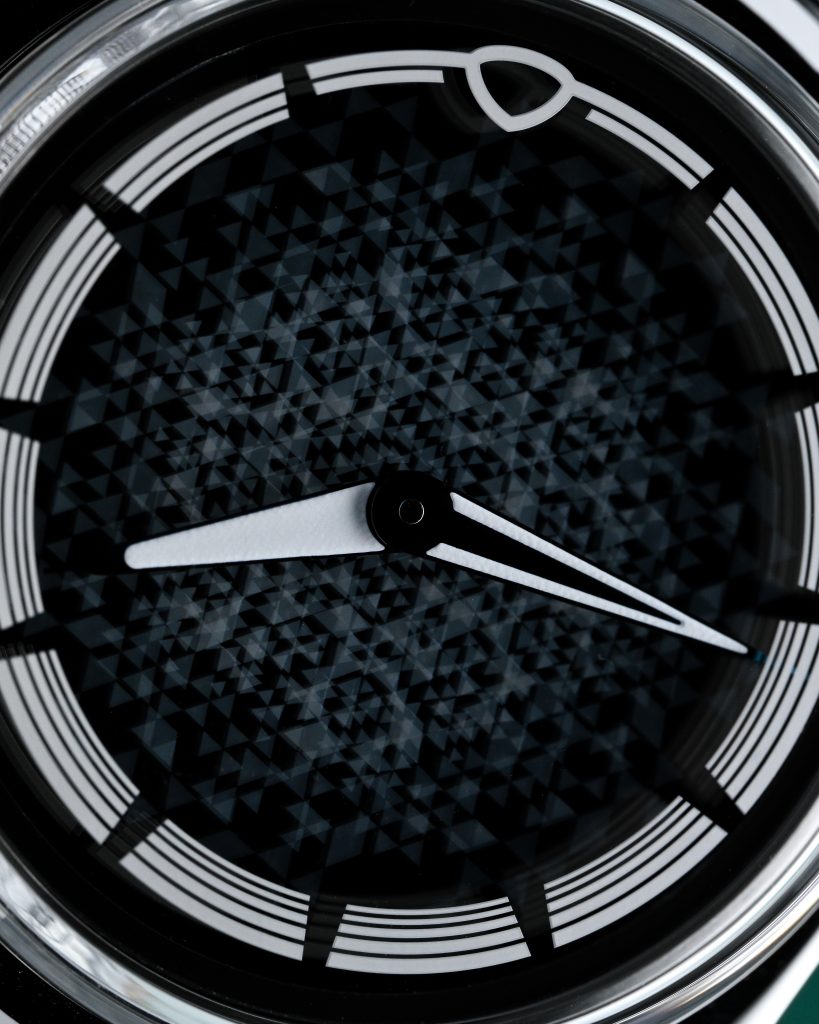
Overall, the dial is comparatively simple by MING standards. None of the materials or design moves are new, but the restraint works in the context of an integrated-bracelet watch, where the case and bracelet are meant to carry more of the visual weight.
Lume performance is mixed. The Polar White elements fade sooner than the hands. The HyCeram case inserts are also relatively weak and somewhat patchy, though that may be specific to the prototype. The hands retain legibility longer, but the narrow minute-hand lume means the hour hand is the only element that remains clearly readable deep into the night.
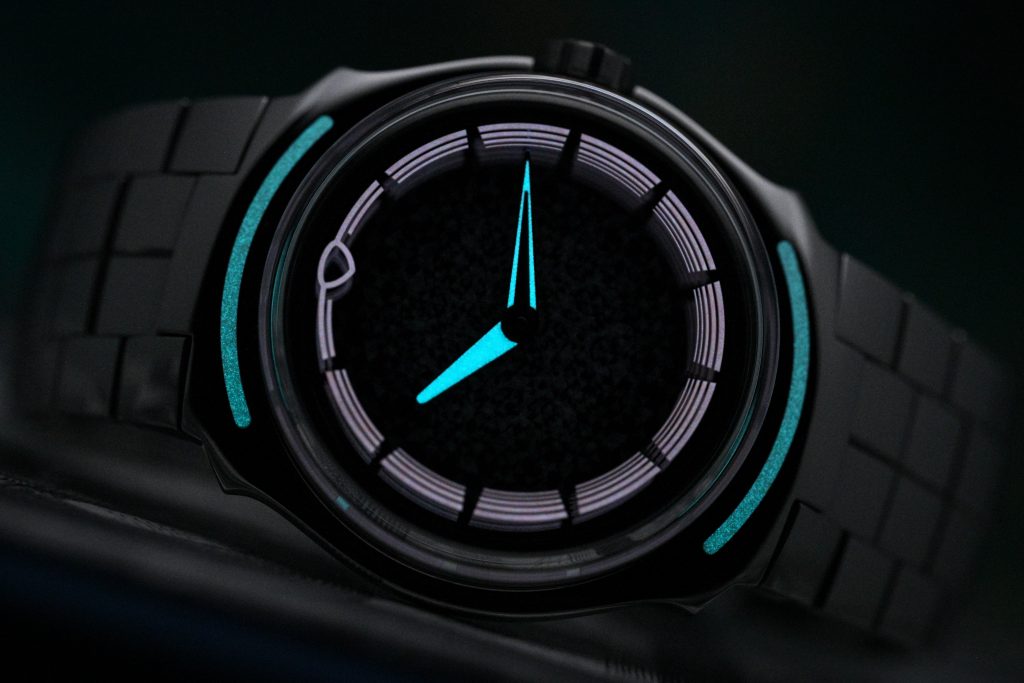
Compared with the Patek Philippe Nautilus 7118 and the Christopher Ward C12 Loco, the Starfield’s lume is adequate but unremarkable. If there’s one area where it objectively under-performs, it’s lume, and that has been common with recent–generation MINGs.
The Star(field) of the Show
Let’s move to my favorite aspect of this watch, and the reason it’s named the way it is: the case-back. Instead of a conventional exhibition back, the Starfield uses a contrasting black (DLC coated?) case-back with a sapphire window that’s been “blacked out” by a dark layer underneath the crystal and interrupted by narrow streak-like cutouts.
Inside is MING’s Vaucher for MING Cal. 3002.M1, a custom-branded execution of Vaucher’s VMF3002 platform. The VMF is a niche movement, but is used by brands like Parmigiani Fleurier, Hermes, Speake Marin, etc. It is somewhat of a high-end work-horse movement with 50 hours of power reserve, and a 4Hz rate. It is a double-barrel automatic movement with a free sprung balance, and looks fairly well finished if you could see it at all.
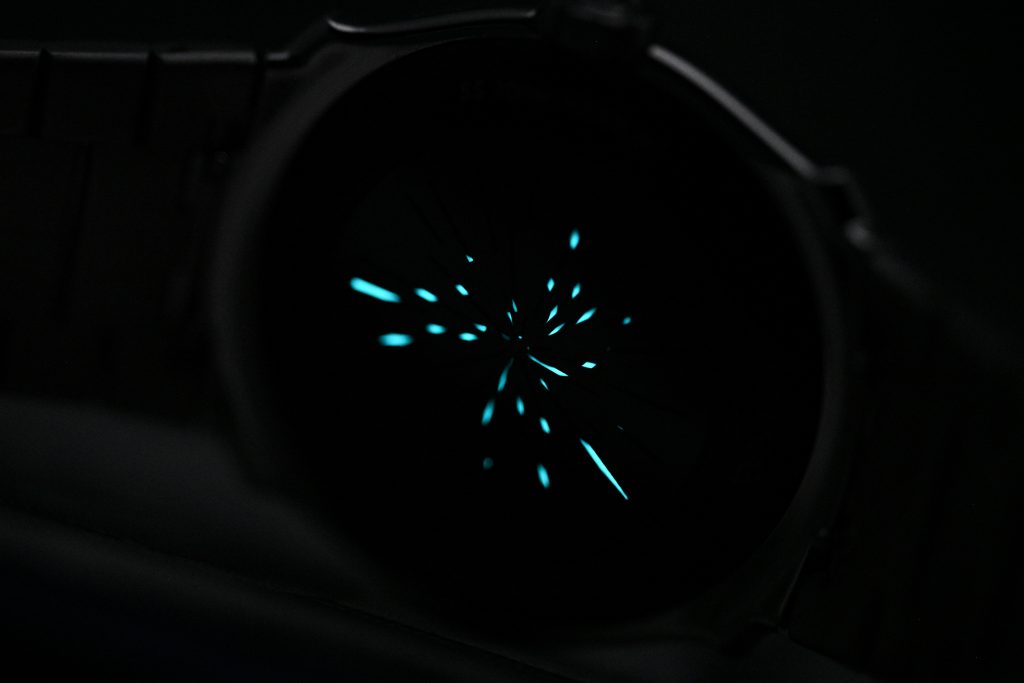
But none of that is what you notice first, because MING developed a proprietary rotor specifically to create the Starfield animation. When the rotor spins (wrist motion or crown winding), a luminous white pattern behind those streak cutouts streaks and blurs into a “warp speed” effect: and it’s especially pronounced in the dark thanks to Super-LumiNova X1 on the animated element. In my opinion, this is one of the most memorable visual experiences MING has ever delivered, and I like that it doesn’t depend on darkness to impress: the streaking effect is impressive in daylight too, even if the lume obviously turns it up a notch at night.
Who Is It For?
At this point, MING’s trajectory is hard to ignore. Between steadily increasing prices, US tariffs, and the USD weakening against the CHF, MING is quickly becoming a brand that’s no longer accessible to everyone who might want one. That said, the 19,500 CHF ask for the 56.00 Starfield feels defensible if you place it in its competitive set against watches like the Moser Streamliner (21,900 CHF), Czapek Antarctique (22,400 CHF), Arnold & Son Longitude ($29,300), Gerald Charles Masterlink ($23,900), and so on.
In this part of the market, you’re not just paying for “an integrated bracelet watch”. Aside from the hype tax you’re paying to play in this genre, you should be paying for design that feels intentional, mechanical solutions that make the watch wear correctly, and a level of execution that doesn’t leave you mentally drafting a list of things the brand should fix in version two. But the Starfield does a great job at meeting those expectations. Before I handled it, I wasn’t fully convinced it would feel meaningfully different from the growing pile of modern integrated-bracelet releases. In hand, I quickly changed my mind. This is a watch that’s designed to feel good on the wrist first, and look distinctive. The aesthetic might not be as radically original as MING at its most experimental, but it’s still original enough within this genre to stand comfortably among the more creative entrants.
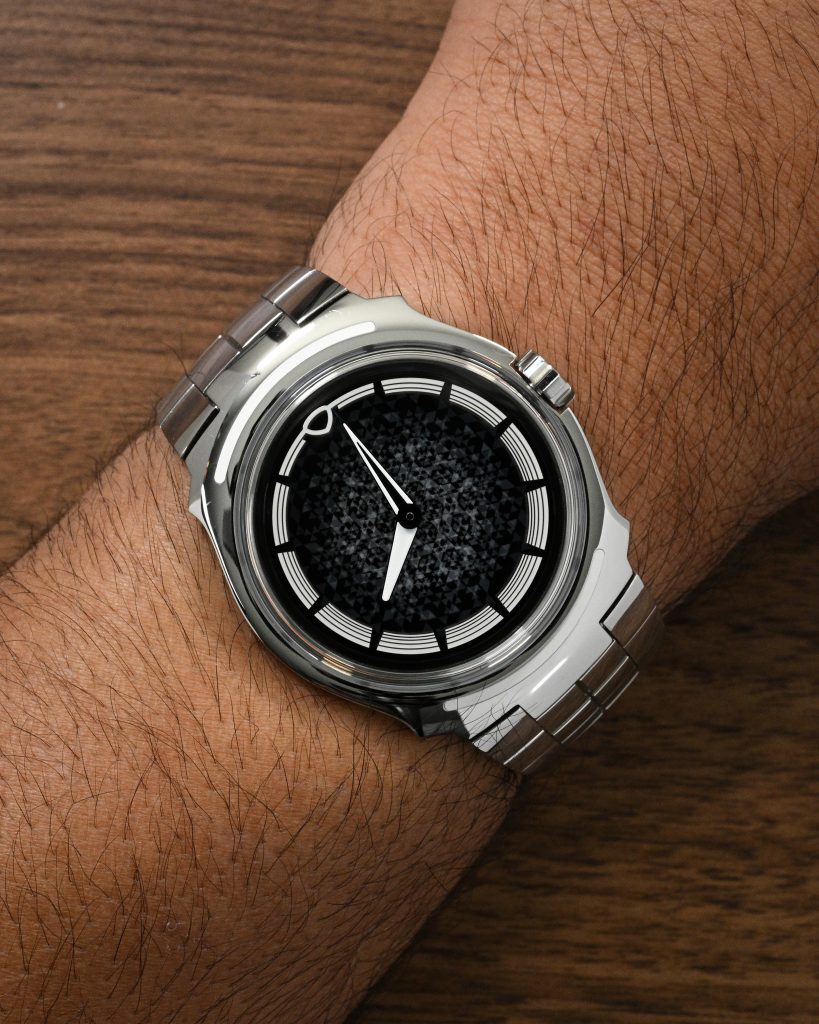
If you’re the kind of collector who loves the integrated-bracelet category but is tired of familiar silhouettes, the Starfield makes a strong case. It’s unusual without being random, and it feels authentic in the way it applies MING’s design language to this format. And the case-back animation alone is the kind of experience that makes the watch feel like it has an identity already.
Of course, the practical problem is that this one is already sold out. With only 20 pieces made, people who now want a Starfield won’t be able to buy one. But if the 56.00 was the proof of concept, there will almost certainly be variations down the road.