Disclaimer: this video/review was not sponsored by Patek Philippe or any other entity.
Video
5950A-001: A Steel Rattrapante Oddball
The Ref. 5950A-001 is one of those Patek Philippe watches that takes a little while to understand: a stainless steel, cushion-shaped, 37mm split-seconds monopusher chronograph with Breguet numerals, ornate engravings, a circular dial inside a tonneau-style case, and what I think is one of the most impressive modern chronograph movements Patek has ever made. It is a very strange watch, but intentionally so, sitting in an unusual corner of the catalogue as a steel grand complication priced like a precious metal watch, built around an ultra-thin movement that was never going to be produced in meaningful volume.
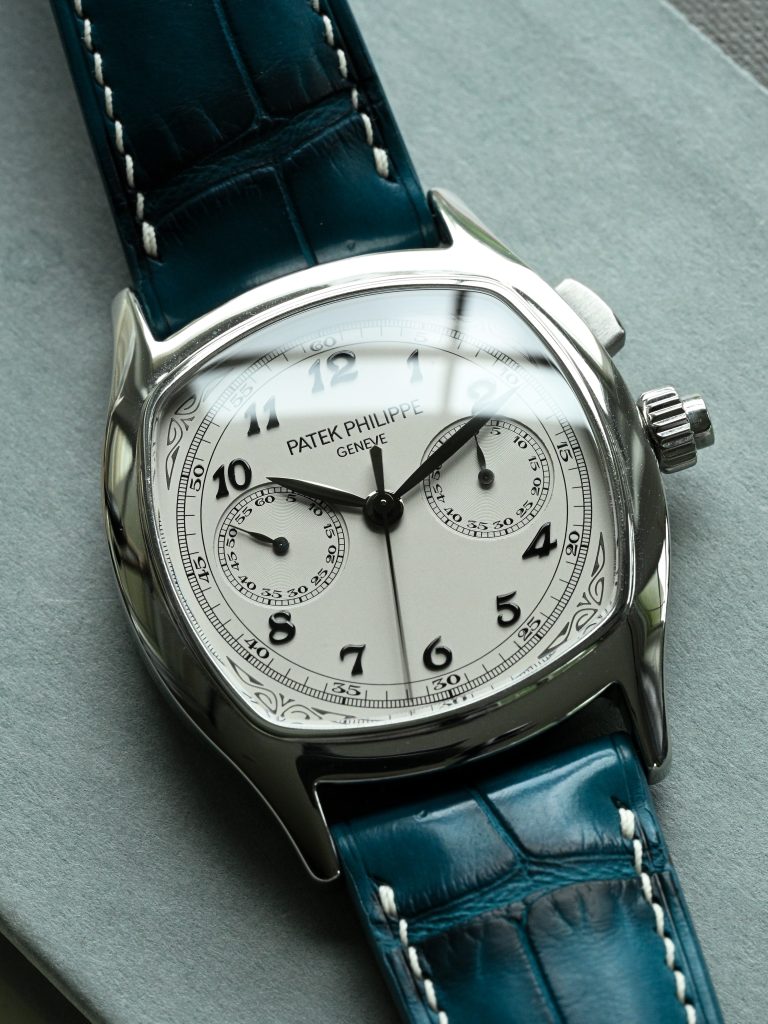
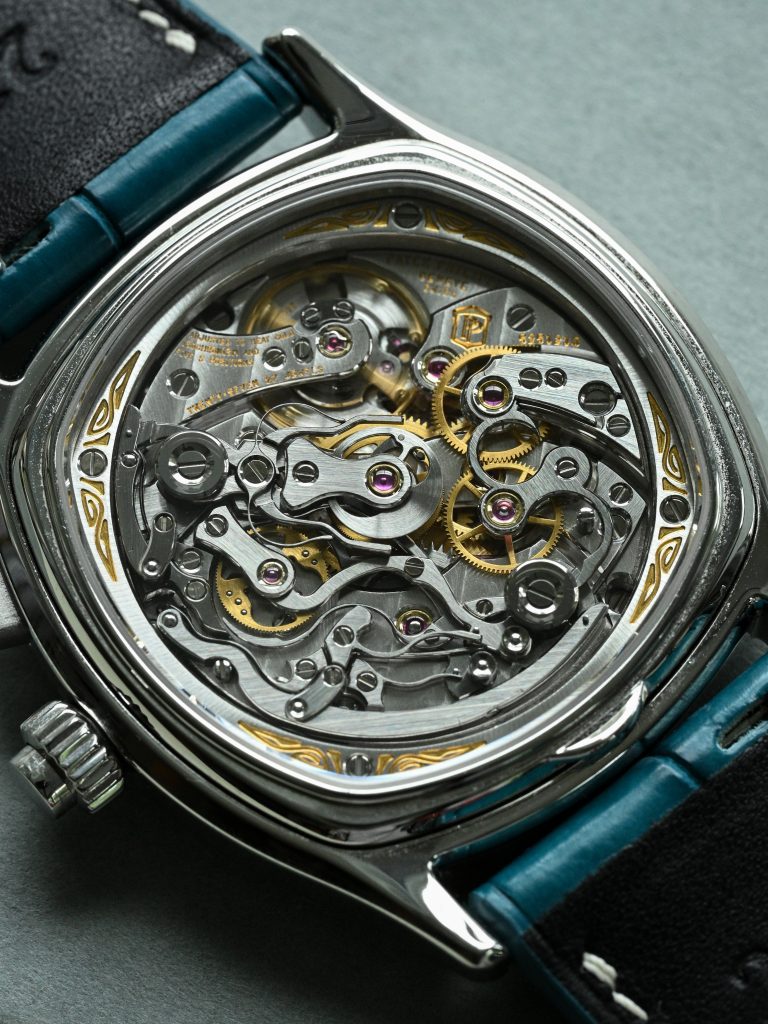
This resulted in a watch that is not as conventionally beautiful as a 5370P, not as familiar as a 5004, and not as quietly classical as the 5959P that came before it. But mechanically, I think the 5950A is one of the most interesting things Patek Philippe has done in the modern era.
Compactness Is A Flex
It was introduced in 2010, five years after the 5959P, and uses the same calibre: the CHR 27-525 PS. The stainless steel case measures 37mm across, 44.6mm lug-to-lug, and just 10.15mm thick, with a 21mm lug width, 30m water resistance, a cambered sapphire crystal, a sapphire display back, and an additional solid steel caseback, which is the sort of extra you expect with precious metal watches and not steel ones.
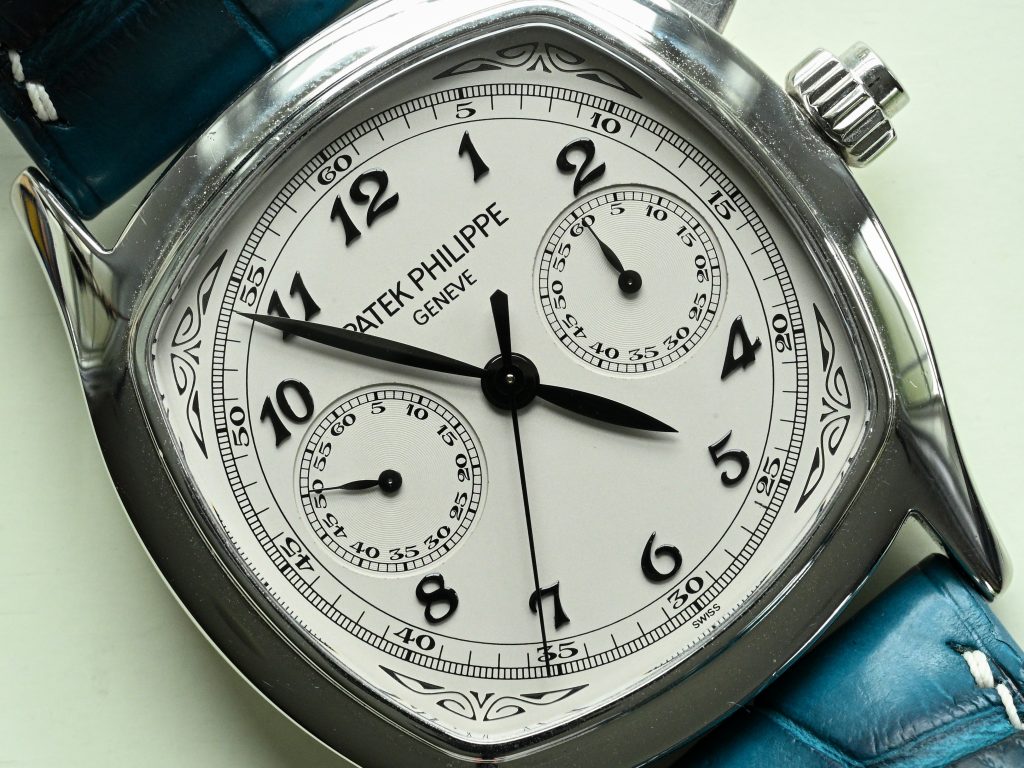
But those dimensions are the point: most affordable chronographs under $10k are already in the 13-15mm thickness range, and that is for a regular chronograph, not a split-seconds monopusher. So putting a genuinely high complication into a 37mm case just over 10mm thick is incredibly impressive; it gives the 5950A the footprint of a modest vintage-inspired dress chronograph, and reminds you that compactness can itself be a form of high-end watchmaking.
Dial
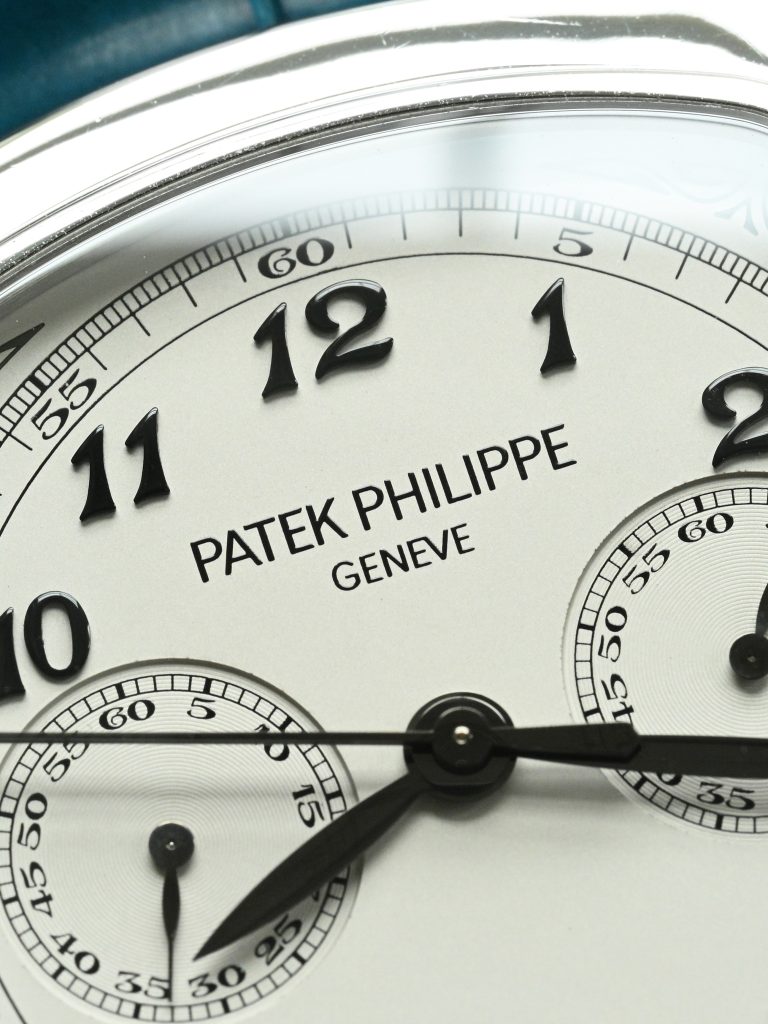
The dial is silvery opaline with a railway minute track, applied Breguet numerals, leaf-shaped hands, and two recessed circular subdials: running seconds at 9 o’clock and a 60-minute chronograph counter at 3 o’clock. The main chronograph is controlled by the crown pusher, while the split-seconds function is handled by the pusher between 1 and 2 o’clock.
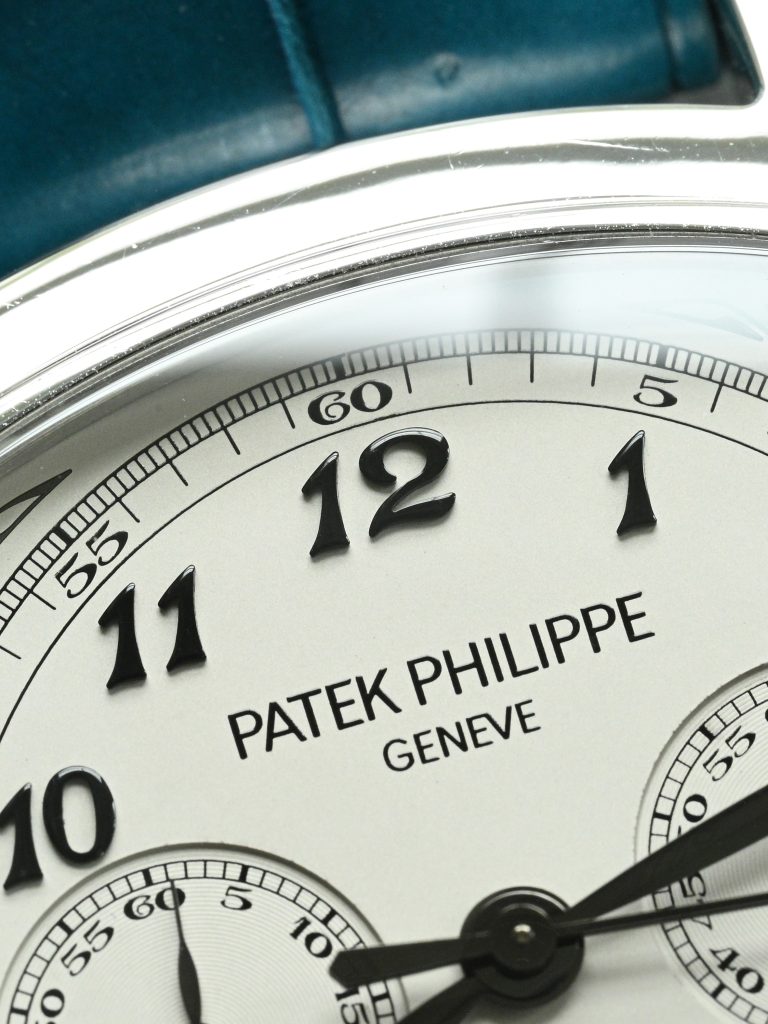
The outer track is crisp, the registers are balanced, and Patek avoids cutting the Breguet numerals into awkward fragments, which is always a huge win in my book. The black-lacquered corner engravings are more divisive, filling the space created by placing a circular dial inside a cushion-shaped case, but I don’t mind them here; the watch is already slightly odd, and the engravings give it a more specific identity.
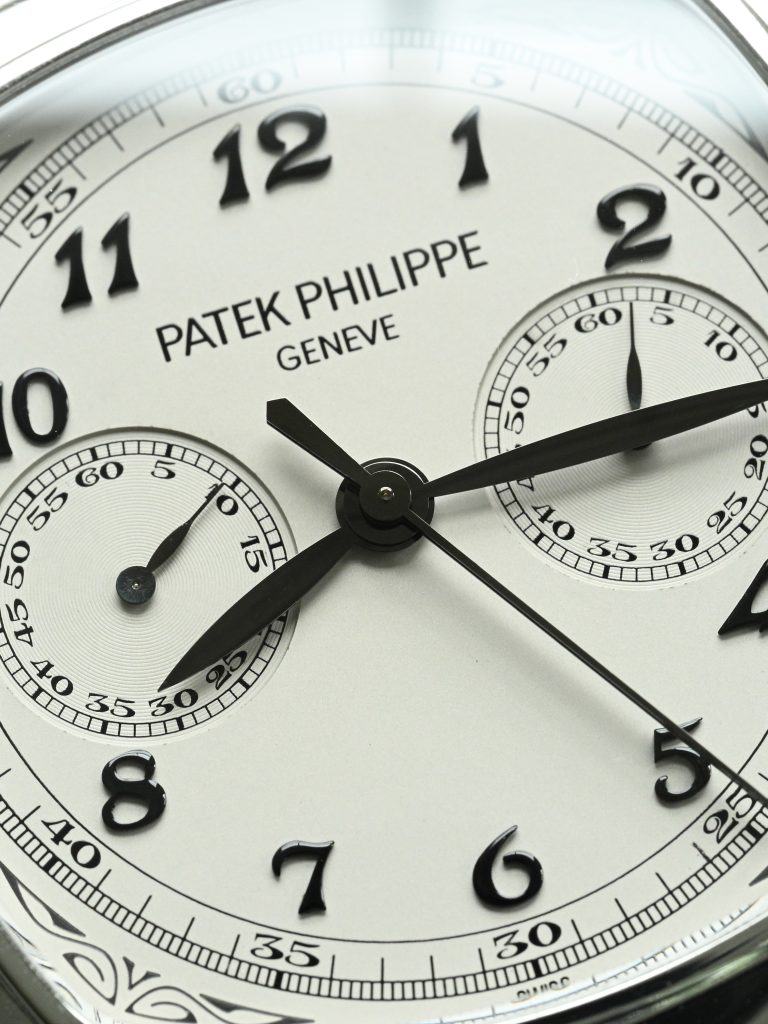
One practical quirk is that the two central split-seconds hands are effectively identical. That is fine for most use, but if you are timing splits more than one minute apart, the stopped hand does not independently track full revolutions. You can work it out using the 60-minute counter and some mental accounting, but at that point you are already dealing with a bit of guesstimation.
The Movement
The reason this watch lives rent-free in my mind is the movement.
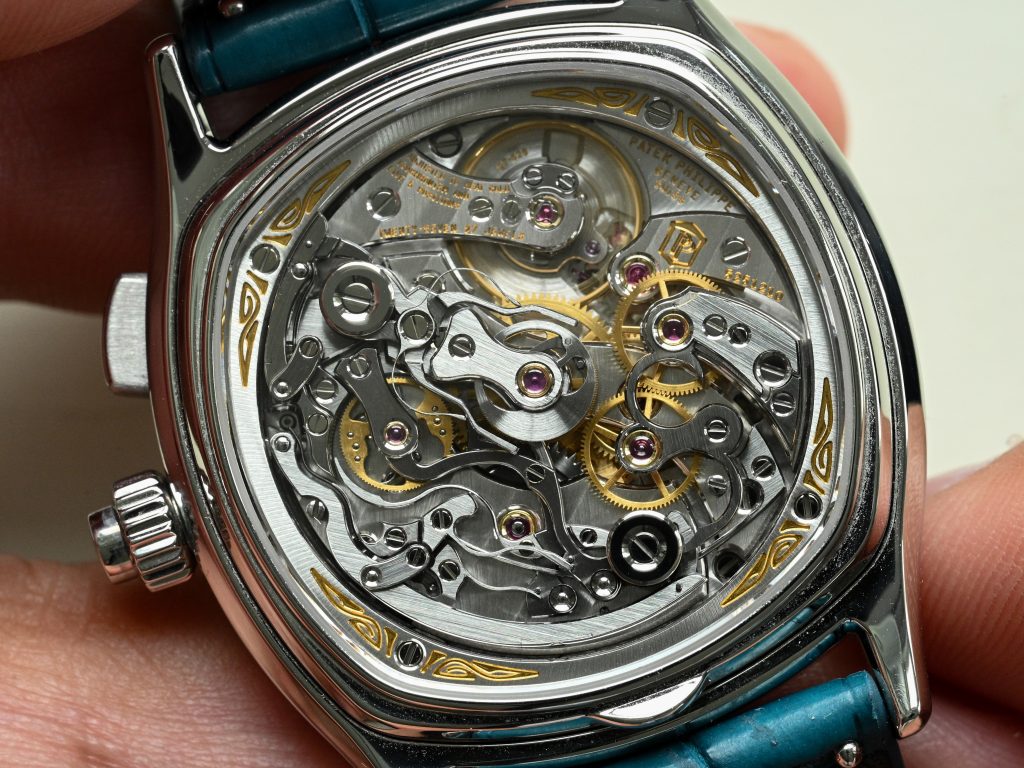
The CHR 27-525 PS was introduced in 2005 inside the Ref. 5959P, and it occupies a very specific place in Patek Philippe’s chronograph history. It is often described as Patek Philippe’s first chronograph movement developed and manufactured in-house, but that needs context. This was not a completely clean-sheet modern calibre; it strongly resembles, and was clearly inspired by, the old Victorin Piguet ébauche architecture that Patek had previously used. But unlike those earlier movements, this was developed and manufactured by Patek as a modern proprietary calibre, and I think that distinction matters.
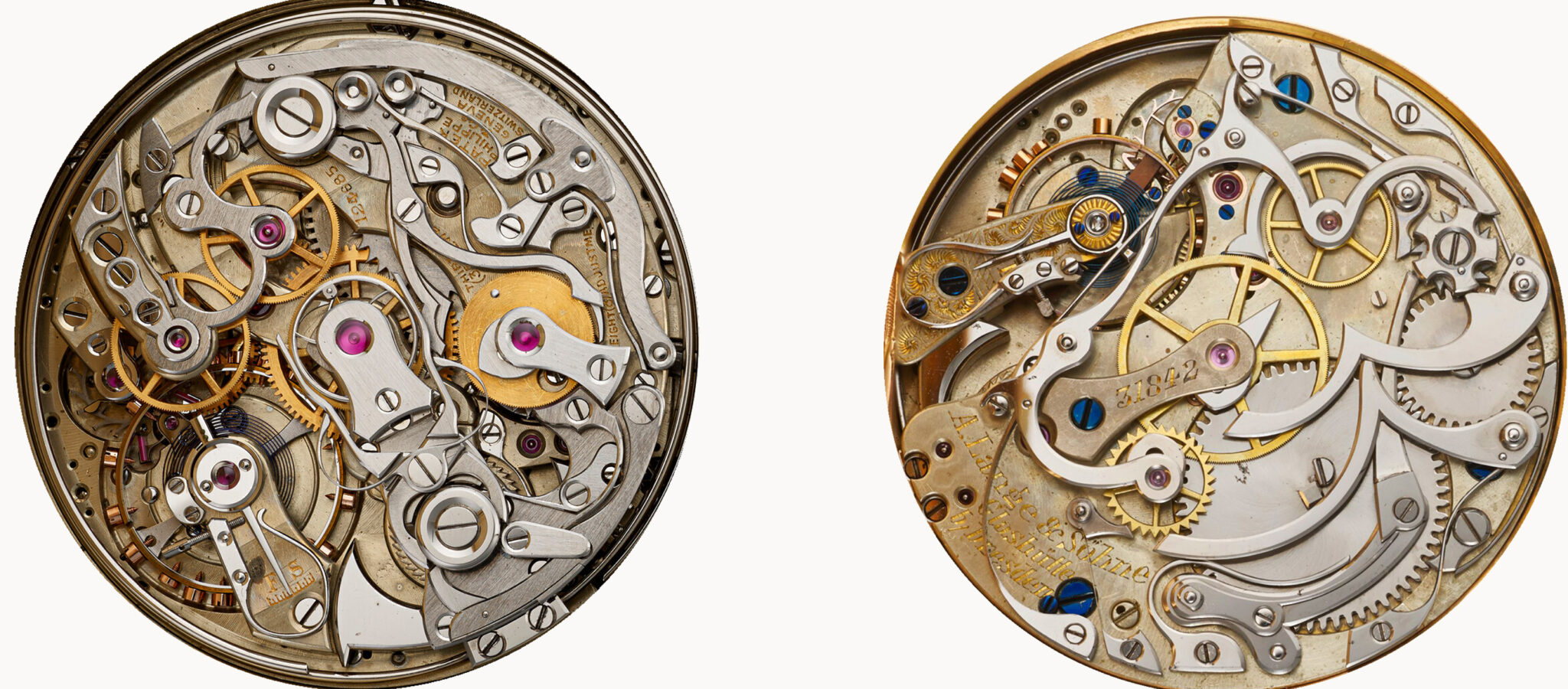
For much of its chronograph history, Patek relied on outside movement specialists, including Victorin Piguet, Valjoux, Venus, and later Lemania. That is not a criticism, because the entire high-end chronograph ecosystem depended on these suppliers.

Many of Patek’s most important chronographs were built from outside ébauches that were then heavily modified, finished, and adjusted in-house, with the 5004 being a good example: a Lemania-derived architecture transformed into one of Patek’s defining split-seconds perpetual calendars.
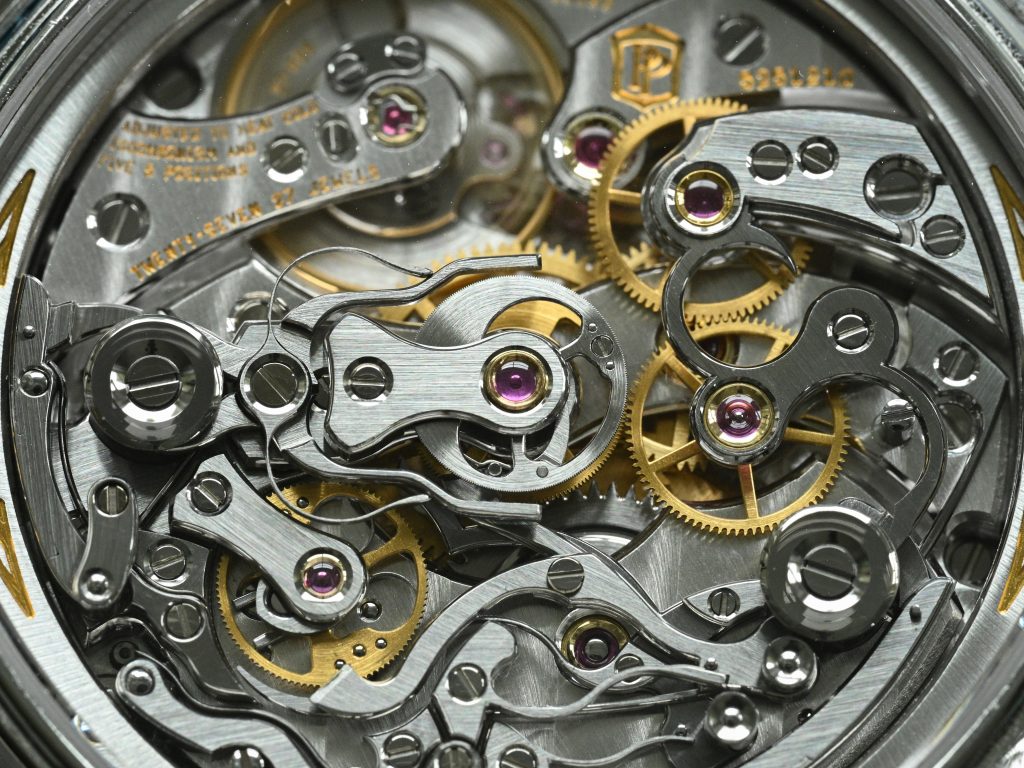
With the CHR 27-525 PS Patek rebuilt that older high-grade Geneva rattrapante language as an ultra-thin proprietary calibre. That makes the movement more interesting to me, not less. It also feels very Patek: spend years developing your first modern proprietary chronograph, and instead of launching it as a safe two-pusher chronograph, introduce it as a tiny 33mm platinum split-seconds monopusher in the 5959P. That watch was too small for many modern collectors, which probably explains some of its niche status, but the movement was clearly the point.
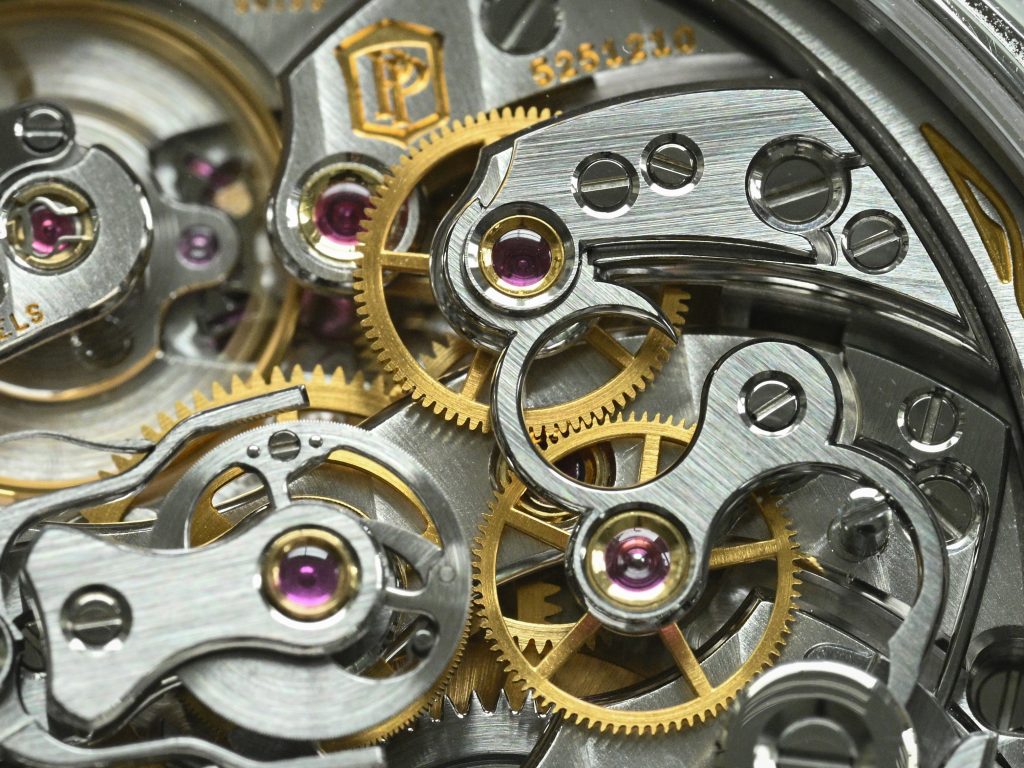
The CHR 27-525 PS measures 27.3mm in diameter and only 5.25mm thick, with 252 components, 27 jewels, a Gyromax balance, a Breguet hairspring, a 48-hour power reserve, and a 21,600 vph beat rate. It is a manually wound, column-wheel-controlled split-seconds chronograph, with the main chronograph operated by the in-crown pusher and the rattrapante controlled by the separate pusher near 2 o’clock. It also carries the Patek Philippe Seal – under the rules in force when the 5950A was launched, cased watches with calibres over 20mm were expected to run within -3/+2 seconds per day, now updated to -1/+2 seconds per day, which is still remarkable for something this artistic and mechanically sculptural.
Why This Is Challenging
There is a lot happening here, but the thinness is the key. A split-seconds chronograph is difficult because you are adding a second central chronograph hand that must stop independently, restart instantly, and catch up cleanly to the primary chronograph hand without disturbing the train more than necessary. That requires clamps, heart cams, reset hammers, isolating mechanisms or equivalent drag-management solutions, and extremely precise adjustment to avoid energy loss, hand flutter, or unreliable reset behavior. Making that work is already difficult; making it 5.25mm thick is much harder, because every lever, bridge, spring, clamp, wheel, and stacked hand height consumes vertical space. That is what makes the 5950A so impressive: the movement is doing something genuinely complicated without forcing the case to become large.
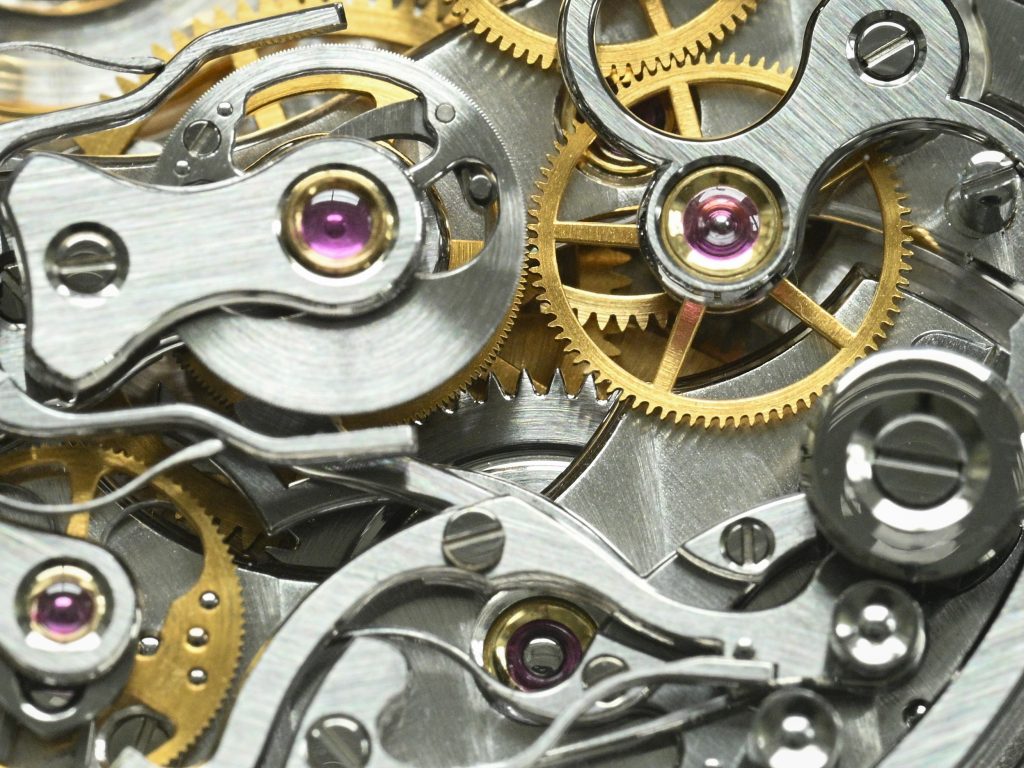
The chronograph minute counter is another interesting choice. The 5950A does not use a jumping minute counter, but instead a continuously running 60-minute counter driven directly through the motion works. Patek’s reasoning was rate stability and torque equalization, since a jumping minute counter introduces a periodic load into the system, while this design helps reduce the difference between the chronograph running and stopped states. This is where part of me wants to ask a stupid question: why not use a remontoire? But that would probably solve the wrong problem. A remontoire may help regulate energy delivery to the escapement, but it would add thickness, power consumption, servicing complexity, and adjustment burden without directly solving the chronograph train’s transient friction issues. Patek’s solution is less romantic, but more consistent with the objective of this calibre: thin, efficient, stable, and reliable.
An Attractive Movement Design
This is not something you would say about every Patek movement, but the CHR 27-525 PS is gorgeous. A lot of that appeal comes from its vintage rattrapante architecture, strongly inspired by older Victorin Piguet-style layouts, but Patek deserves credit for translating that language into a modern calibre with real reliability, dimensional discipline, and long-term serviceability.
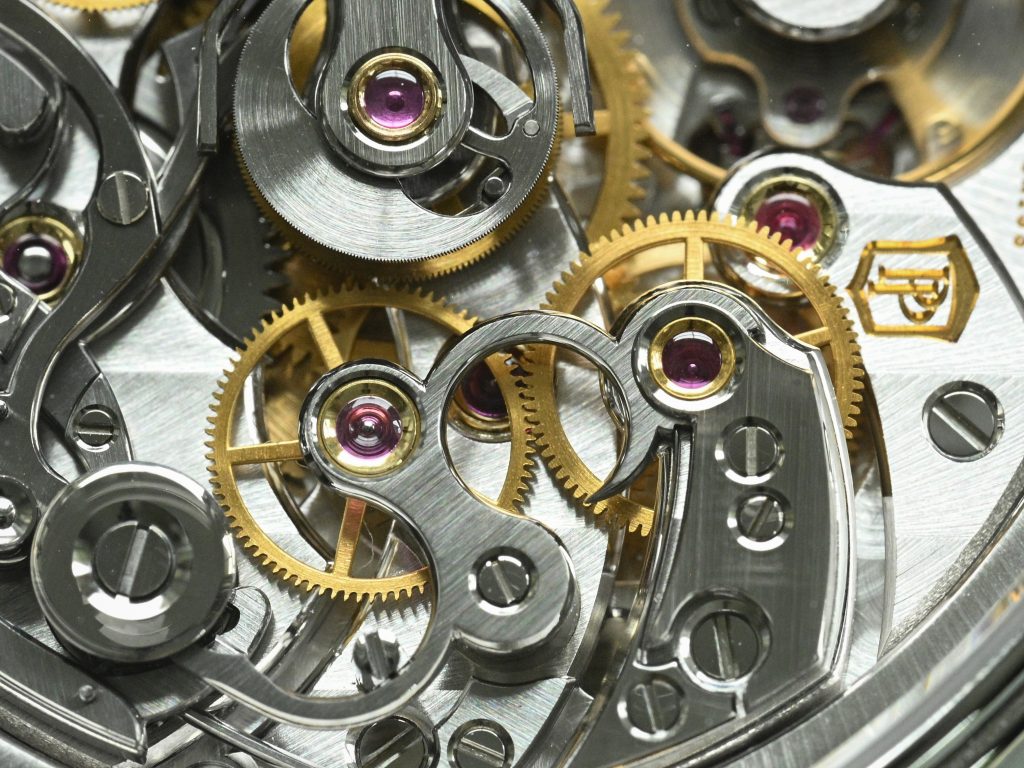
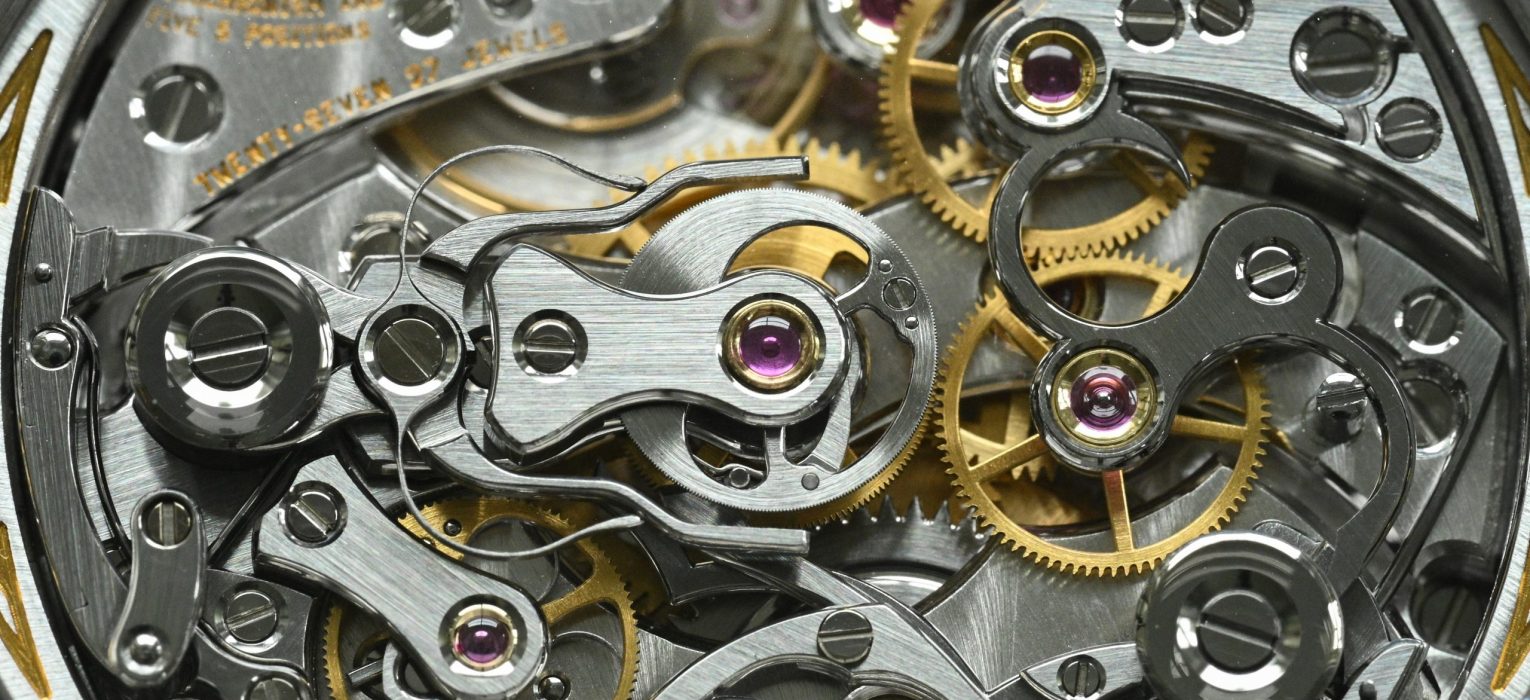
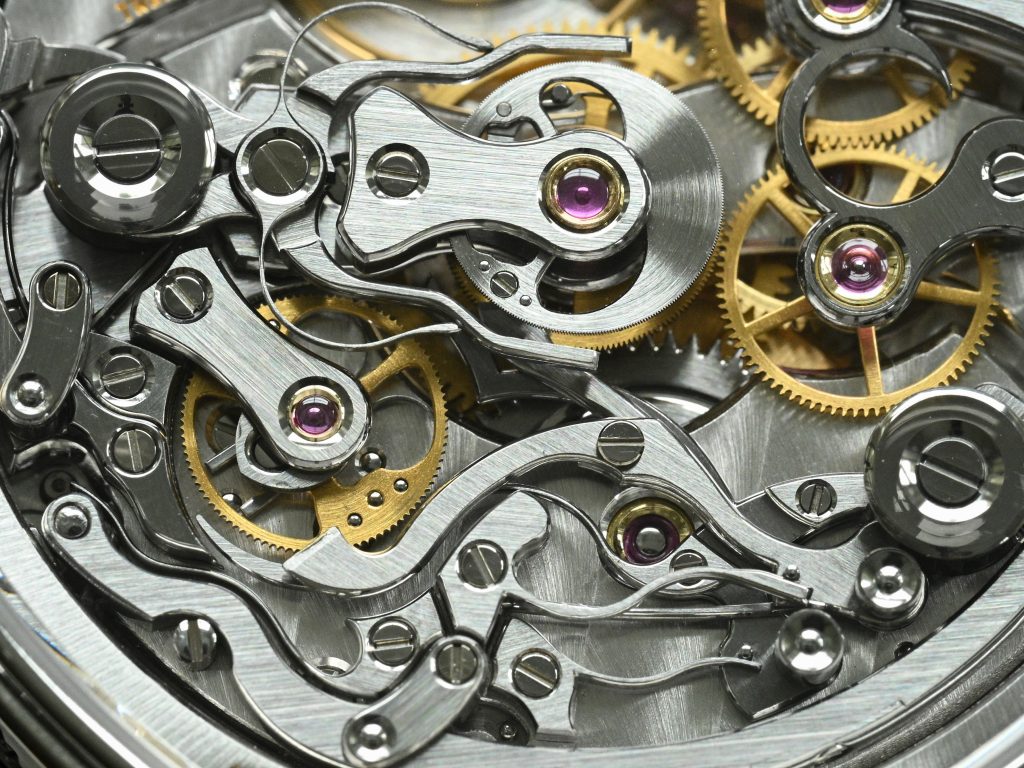
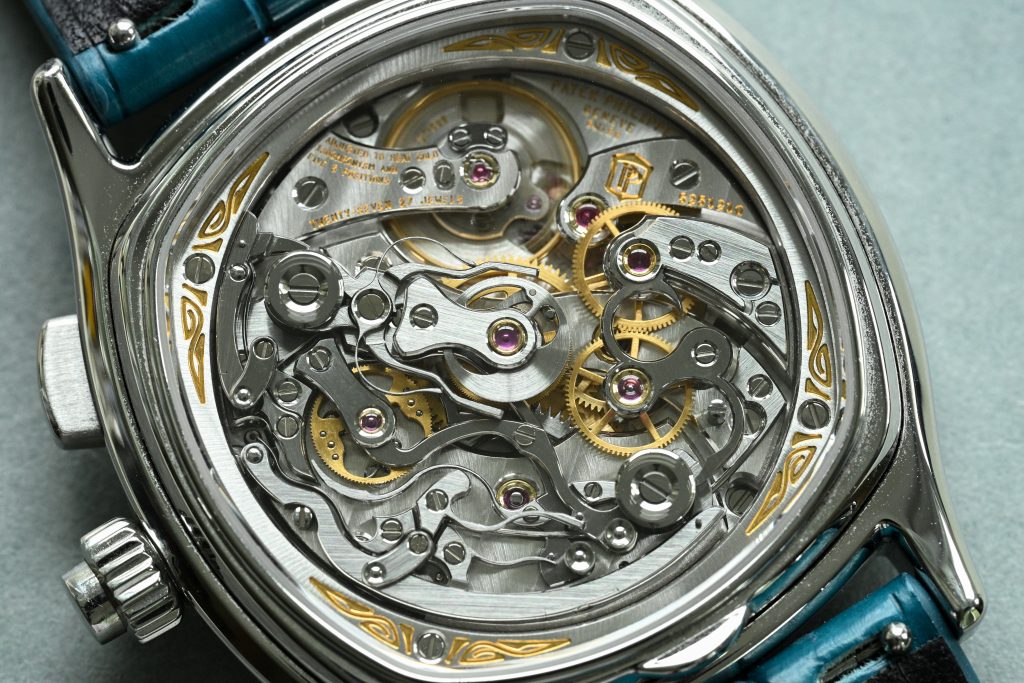
Through the back of the 5950A, the movement has a wonderful amount of visual complexity: dark steel chronograph components layered above lighter rhodium-plated bridgework, with the split-seconds mechanism rising at the center and the levers, springs, clamps, wheels, and bridges spreading outward from there.
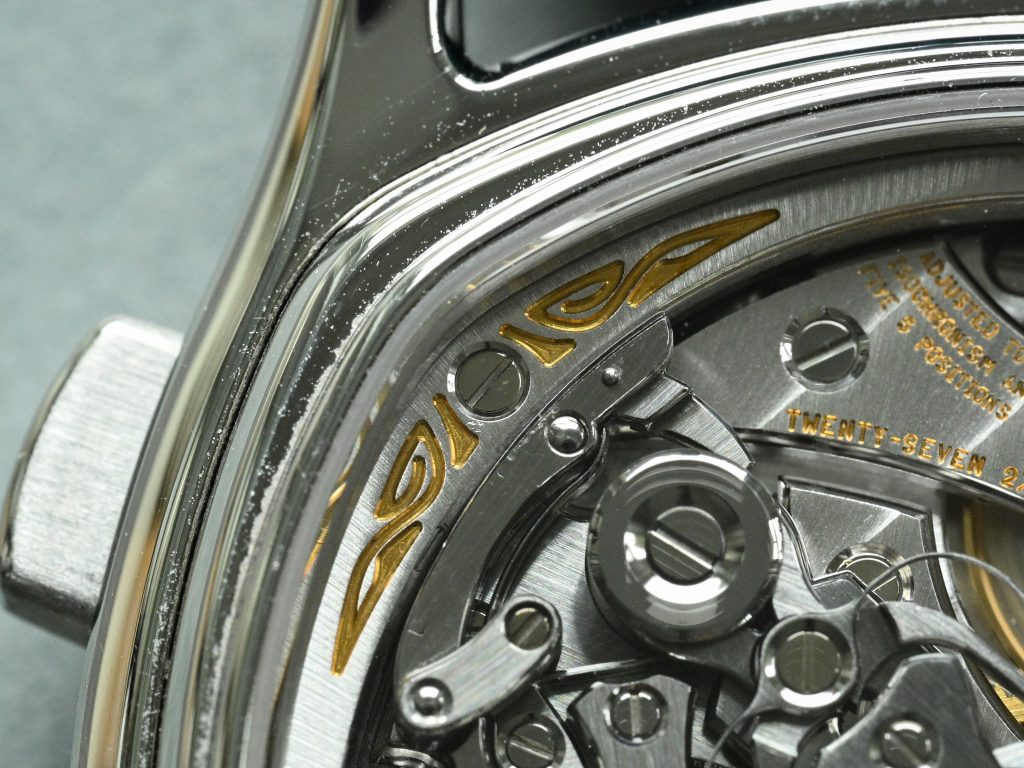
The finishing is also excellent, with interior angles, exterior angles, thick polished bevels, straight graining, circular graining, polished screw heads, black-polished steelwork, and a variety of bridge and lever shapes that keep the movement visually active without becoming messy. The caseback framing helps too, with a satin-finished ring and gold-filled corner engravings that match the ornate language on the dial side.
Wrapping Up
The total number of 5950s made across all variants is not publicly confirmed by Patek, so I would be cautious with anyone giving a precise figure. But based on the known variants and how rarely these watches appear publicly, I would think of the entire 5950 family as a low-hundreds production story rather than anything close to regular production.
The 5950A had a final retail price of CHF 441,600, which by traditional collecting behavior is a ridiculous number for a 37mm steel watch… until you remember what is inside it. In that sense, the case material almost becomes part of the provocation. Patek was not trying to make a steel chronograph for everyday practicality. It was definitely making the point that even in a steel case, they could successfully sell a grand complication watch with a movement finished to this level.
To wrap this up, I have no business discussing the collectibility, value, or long-term investment potential of a watch like this. I also have no interest in doing so. But as a watch enthusiast, a novice chronograph enthusiast, and someone who deeply appreciates fine movements, being able to spend time with something like the 5950A is genuinely priceless. It is the kind of experience you do not forget.
And while many people like to say they are in this hobby for the people, I am not one of them. After more than a decade around watches, I find many of the people to be fairly unflattering. I am in this hobby for the watches, and certainly for watches like this one.