
Disclaimer: this video/review was not sponsored by Audemars Piguet or any other entity.
Video
Royal Oak Chronograph 26240ST: Respecting The Icon
Reviewing a Royal Oak is a bit difficult because the watch arrives with all its mythology already attached: the octagonal bezel, exposed screws, integrated bracelet, Tapisserie dial, and the idea that this is the original luxury steel sports watch. I respect that history, and the modern Royal Oak Chronograph is one of its many descendants.
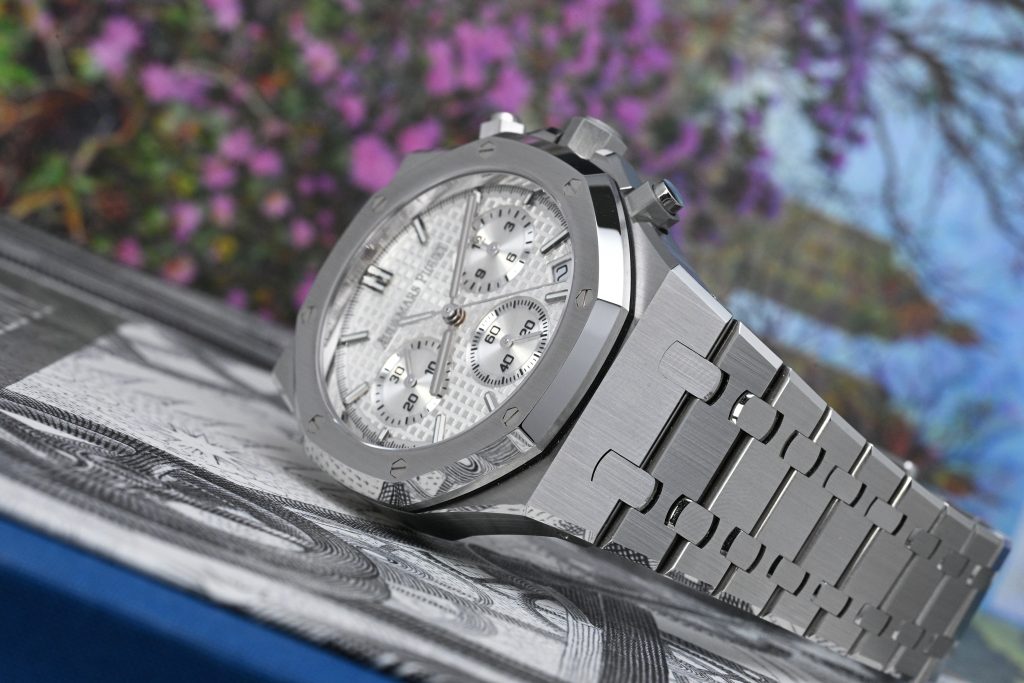
This is the Audemars Piguet Royal Oak Chronograph Ref. 26240ST.OO.1320ST.07, the stainless steel model with the silver Grande Tapisserie dial and matching subdials. It is priced at $44,100, measures 41mm in diameter and 12.4mm thick, has 50m of water resistance, a screw-locked crown, sapphire crystal and caseback, white gold applied markers, lumed hands, and a stainless steel bracelet with AP’s typical folding clasp.
This example belongs to a friend and was brand new when I photographed it. He had not seen it yet, so I did not size the bracelet. That is why some wrist shots have the bracelet gap stuffed with a cloth, and why my wearing impressions are a bit more high level.
Let’s check it out!
26240 Generation
This generation brought Audemars Piguet’s in-house Calibre 4401 into the steel Royal Oak Chronograph, replacing the older Frédéric Piguet-based generation with a modern integrated automatic chronograph. The 4401 is a flyback chronograph with a column wheel, vertical clutch, 40 jewels, 381 components, a 4Hz beat rate, and a 70-hour power reserve. It measures 32mm wide and 6.8mm thick, which explains some of why this generation is thicker than older Royal Oaks.

The movement feels refined, the pushers have a clean action, and the smooth flyback operation gives an overall high end operating experience. I did not remove the bracelet because there is no easy way to do it, so I do not have much movement footage here. From the caseback side, the 4401 and 4404 in the Royal Oak Offshore Chronograph are practically identical, so my Offshore review gives a better look at this movement family.

My thoughts on the movement carry over from the Offshore review: the movement is solid, decent looking, and refined to operate, but also very industrial. There is not much here that feels human-intervened or emotionally rewarding under magnification. The typical AP crowd may not care, but at this price I think better finishing is warranted. Even Patek, despite fair criticism for conservative finishing, appears to put more effort into its movements at these prices.
Proportions & Style
Externally, the Royal Oak Chronograph makes a stronger argument for its price. This unsized example weighed 172g, but it does not feel crude. The case and bracelet are thin, sharply constructed, and visually dense.


I measured the mid-case at 6mm and the bezel at 4mm. The dial is 31.5mm, surprisingly identical to what I measured on the Royal Oak Offshore Chronograph. The bracelet tapers from 26mm to 17.8mm, and the links are 2.5mm thick, almost half the thickness of the Offshore Chronograph’s bracelet links. That contrast explains why this feels much more refined than the Offshore, even though the two share related movement architecture.
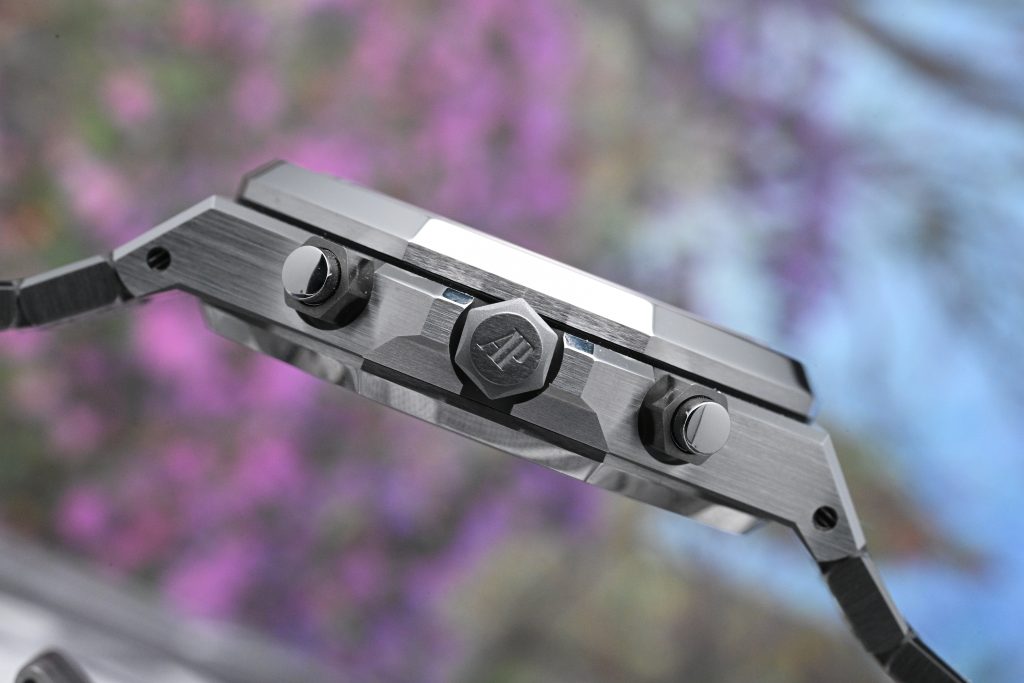
The case finishing is excellent. If you like angular design, it does not get much better than this. The brushing, polished bevels, crisp transitions, and flat architectural surfaces are impressive. The bracelet is also very well finished, with excellent build quality, beautiful bevels, and strong contrast between brushed and polished surfaces.

The dial is more complicated. The silver Grande Tapisserie has a bright, almost iridescent, mother-of-pearl-like appearance, which looks incredible up close but is not the greatest for legibility. The chronograph information can get lost depending on the light. But under macro, the Tapisserie pattern has real texture and depth, the circular subdials are nicely defined, and there is a subtle transparent layer between the circular textured subdials and the printed text that I did not realize existed until filming it. The lume is mediocre, almost the same as the Offshore Chronograph.
The Bracelet Question
This is where I will probably get the most flak, but I genuinely do not understand all the hype around the Royal Oak bracelet. Visually and historically, I get it, and in a few references like the Jumbo things come together in a convincing manner. The original Royal Oak is one of the most important integrated bracelet designs ever made, and this modern version is finished to a high standard. It is also a class above bracelets from Czapek, Christopher Ward, Tissot, and most watches trying to play in this genre.

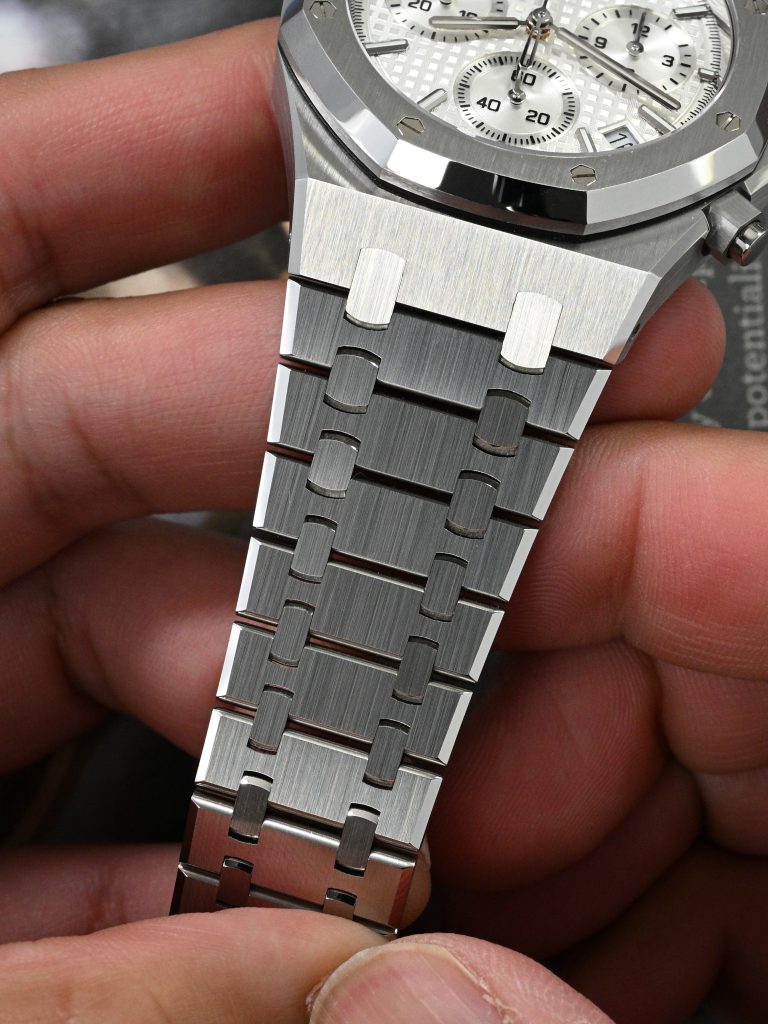
But comfort, fit, and feel are different questions. I think I am more of a Patek Philippe Nautilus bracelet person. The Royal Oak bracelet is beautiful, but I would like on-the-fly adjustability, and some sharper link edges could use more micro-bevels. Patek Philippe, Vacheron Constantin, IWC, and others have heavily updated their integrated bracelets over time, and AP still has room to make this more ergonomic without damaging the design.
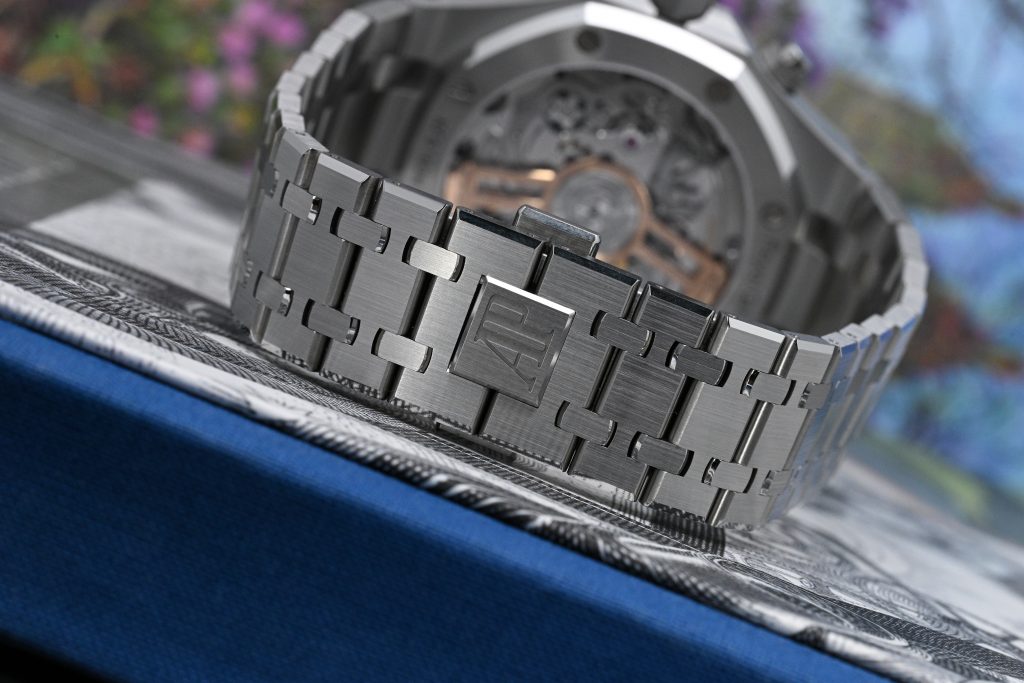
Size matters too. This is listed as 41mm, but because of the crown guards, pushers, crown, flat case profile, and bracelet span, it wears more like a 42.5mm watch. I measured a minimum span of 50.5mm given how the links articulate, so this is not a small or forgiving 41mm watch. It fits my 6.75-inch wrist well, but the flatness and bracelet span make it wear larger than expected. For this style of watch, I would personally prefer the 38mm model.
Wrapping Up
The case, bracelet finishing, dial construction, and build quality are outstanding, and if you like AP’s angular design language, this is one of the best-executed versions of the idea.

But it is not beyond criticism. The lume is average, the dial is not always legible, the bracelet could be more ergonomic, the size wears larger than the spec sheet suggests, and the movement finishing feels too industrial for the price. The Royal Oak Chronograph justifies a lot of its $44,100 externally. It is a beautifully made object, but respecting the Royal Oak and fully buying into the hype are not the same thing.