Disclaimer: This watch was sent to me to review, and I do not need to return it after my review is complete. This watch was given to me without restriction and is not contingent upon a particular outcome for my review. All opinions here are my own, and VIIS had no influence over the opinions stated here.
VIIS Flieger GMT 42 Velebit: https://viiswatch.com/en/collections/all/products/flieger-gmt-42-velebit
Video
Review
Flieger watches are one of those genres where the design constraints are the point. The classic pilot-watch codes are intentionally uniform: big Arabic numerals, stark minute track, high contrast, and zero fuss… so they can all start to blur together if you’ve handled enough of them. And when you’re a new micro-brand trying to enter that space, you’re not just competing with other newcomers; you’re also stepping onto home turf occupied by brands with real legacy or credibility in the category, like Stowa, Laco, Hanhart, and plenty of other staples from the area that have been iterating on this template for decades.
That’s the backdrop for VIIS, a young brand founded by Josip Kožul and his partner Leonie, with VIIS describing 2024 as the moment the brand was born out of a shared love for aviation. And while it’s easy to be skeptical of yet another flieger-shaped object entering this crowded lane, there are real advantages to being a new player in an old game. You can be more flexible, react faster to feedback, and try to evolve the formula without carrying the baggage (or the expectations) that come with a historic name on the dial.
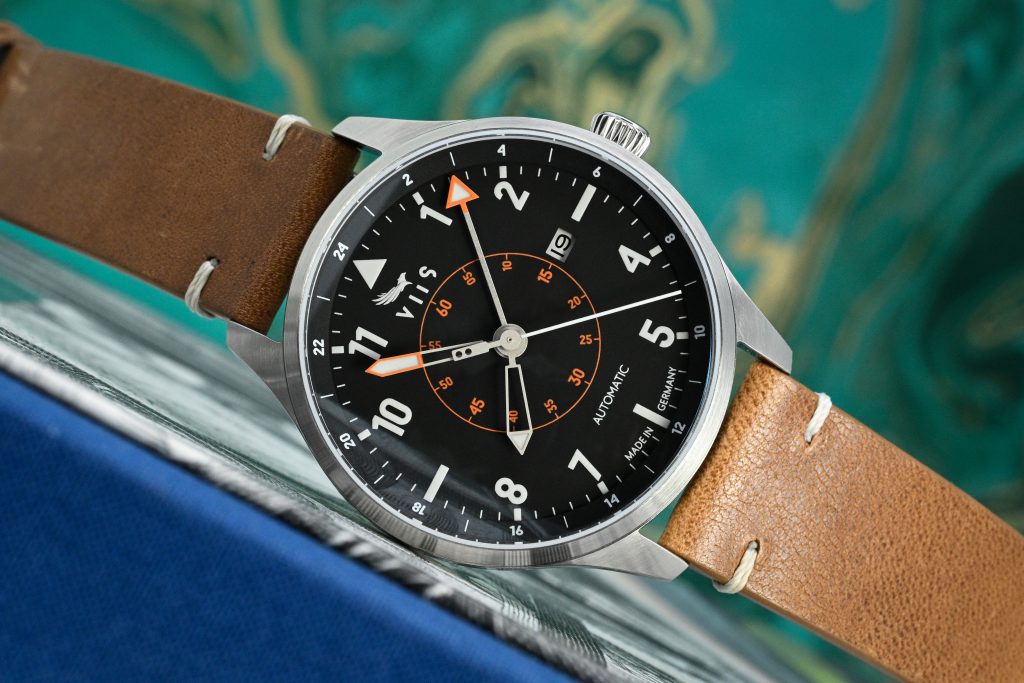
Today we’ll be taking a look at the VIIS Flieger GMT 42 Velebit, which is priced at $698 USD. If you’re buying from the US, VIIS notes that additional import fees/taxes may apply so it is reasonable to think of this watch as roughly ~$770 delivered assuming the current 10% tariff policy. One last point worth clarifying up front: VIIS states their watches are “designed, manufactured and inspected” in Germany. At the same time, the Flieger GMT 42 uses the Japanese Miyota 9075, so the most grounded way to interpret that is the watch is designed, assembled, and quality controlled in Germany, with globally sourced components, some of which may indeed be made in or around Pforzheim, rather than implying every component is German-made.
Let’s check it out!
Case
The Velebit’s case feels very much in line with what you’d expect from a flieger, both in sizing and in overall execution. I measured it at 41.75mm in diameter, 48.6mm lug tip to lug tip, and 13mm in overall thickness. That thickness figure includes a fairly prominent ~1.5-2mm curved sapphire crystal, and the watch has a 20mm lug width, which makes strap pairing straightforward.
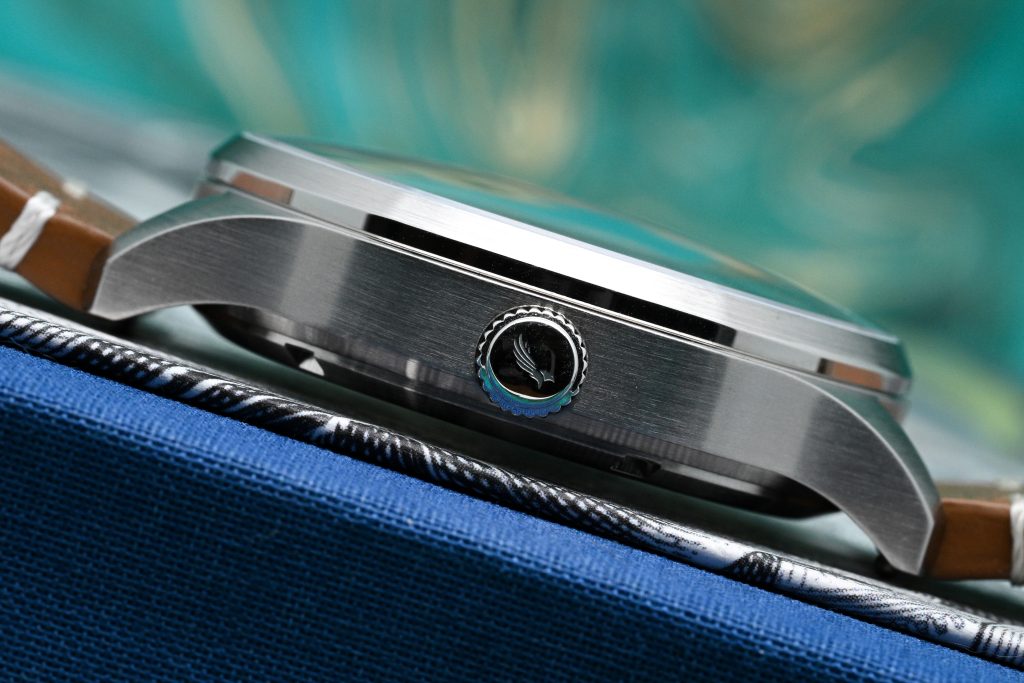
The case is entirely stainless steel and the finishing is appropriately utilitarian. It’s almost all brushed, with the one real visual break being a polished flank along the side of the bezel that adds a bit of contrast. The lugs, unlike the flatter, more slab-like lugs you often associate with traditional flieger designs, curve down quite a bit. This helps with ergonomics and does a good job of making the watch sit on the wrist with a bit more stability.
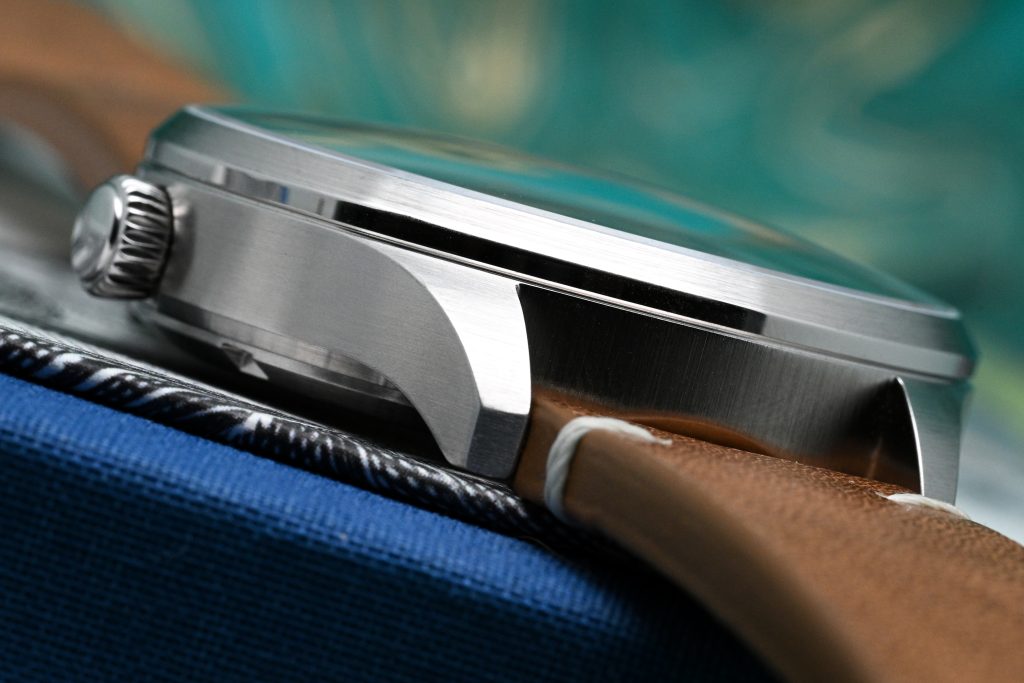
The 13mm thickness is influenced by the curved sapphire, and I generally prefer a flat crystal on a watch like this. Between the curved crystal, the 5.6mm signed screw-down crown, and the screw-in case-back, VIIS is able to deliver 100m of water resistance, which is unusual for a flieger-style watch, and a meaningful usability upgrade.
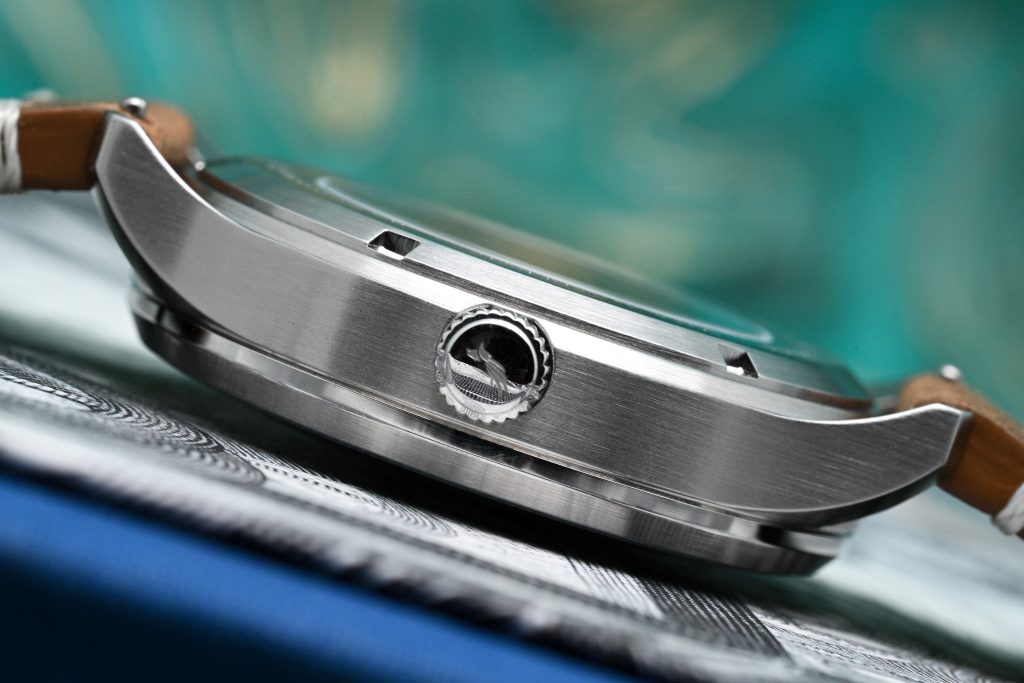
The crystal has internal anti-reflective coating, but the curvature combined with the lack of external AR means it can pick up reflections pretty easily. Overall, the case design itself is fairly generic and doesn’t really try to reinvent the flieger silhouette (which I would’ve liked to see), but it’s well executed, wears comfortably for its size, and the water resistance is reassuring.
Dial
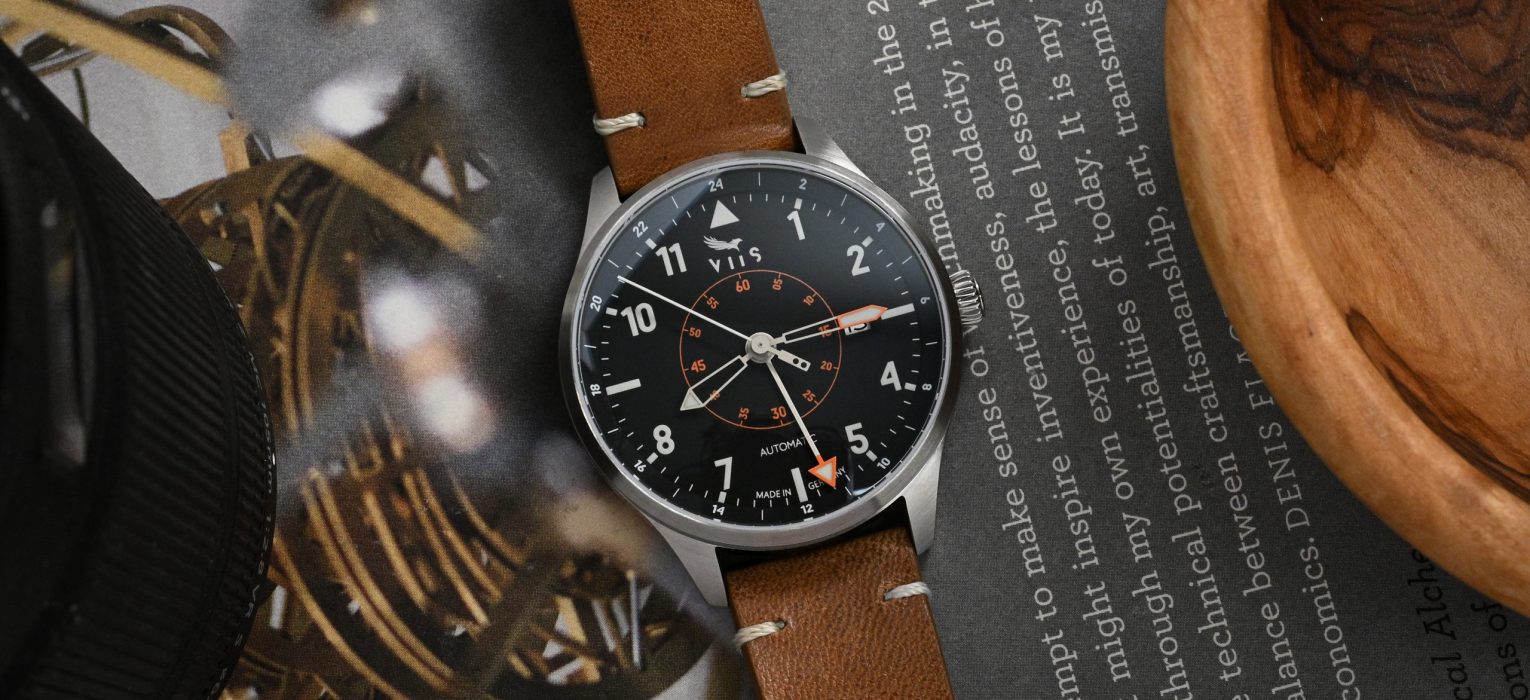
The Velebit’s dial is where VIIS most clearly tries to balance recognizably flieger with not a straight reissue. The fundamentals are all here: a matte black base, high-contrast printing, and the familiar triangle at 12, but the layout is best understood as Type B-inspired rather than a strict reissue. Classic Type B dials prioritize the minute scale (often an outer 5-55 ring) with hours taking a secondary role, but VIIS keeps their focus on the hours while in their execution.
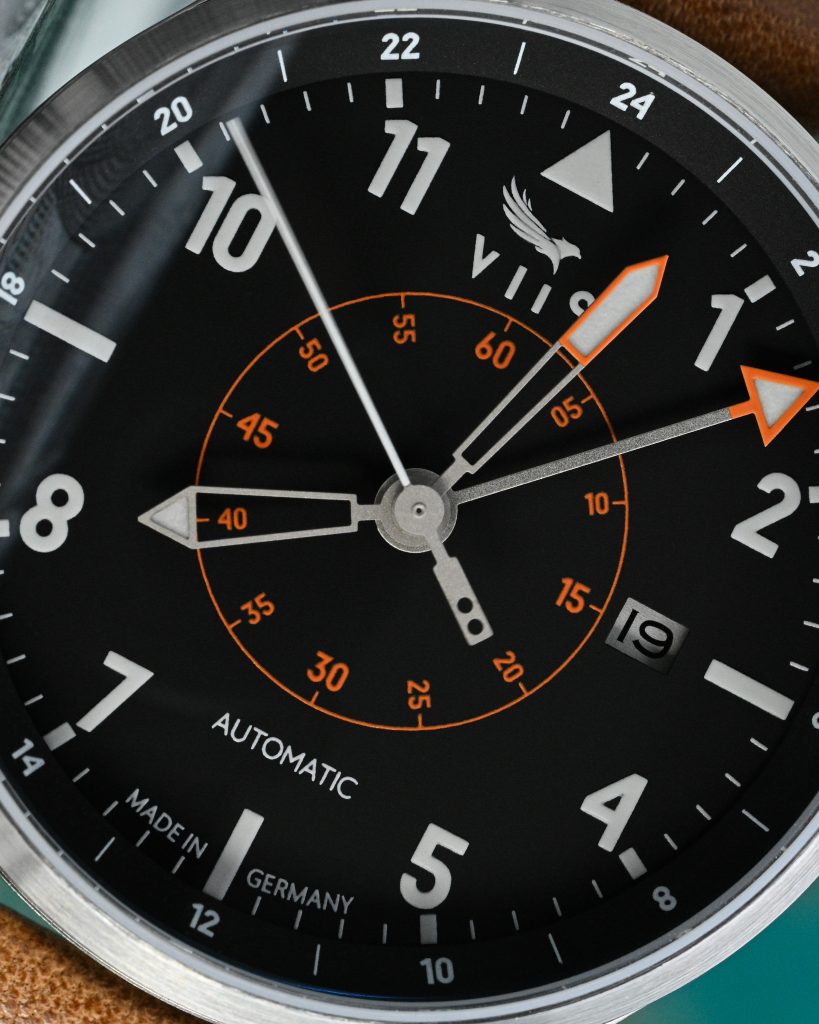
Instead of pushing minute numerals to the outermost ring, VIIS uses a bold internal orange minute track marked 05 through 60, which gives the dial a different focal point compared to a Type B flieger. I personally love the way the orange elements play together here: the orange minute hand, the orange GMT accents, and that inner orange ring create a cohesive theme without making the watch feel loud. Around that, you still get oversized Arabic hour numerals and rectangular hour plots, plus a clean logo and word-mark under 12.
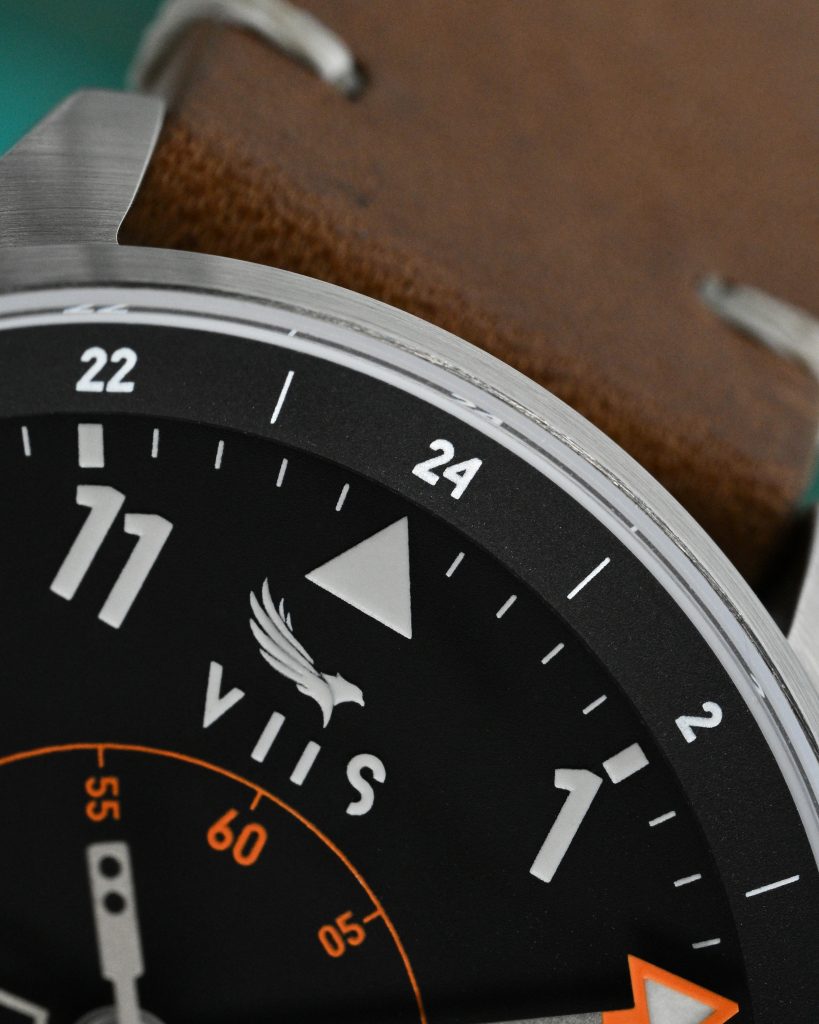
The GMT function is integrated in a way I really appreciate: the 24-hour reference is kept to the chapter ring, so the dial stays cleaner than many GMTs in this format. It does add information density, but it avoids the clutter that can come with busy GMT dials. The hands help a lot too: the proportions are excellent, and the skeletonization feels intentional, keeping the hands from obstructing the inner minute ring. The GMT hand is distinct with its arrow tip and orange detailing, and the seconds hand stays thin enough to remain in the background, but with enough contrast to stay visible.
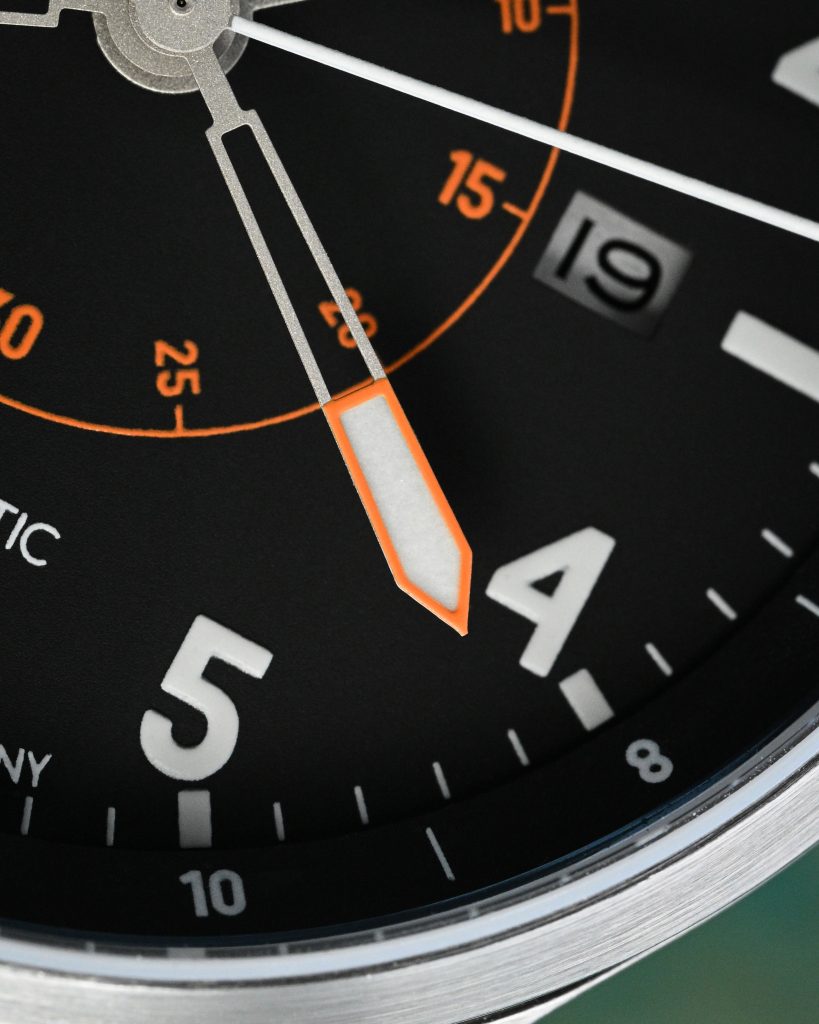
There are also some quieter design choices that stood out to me. The “4” uses a more stylized, distinctive form, and what’s nice is that this typeface is applied consistently across the dial elements rather than mixing fonts; the date wheel is the one exception. One area for improvement is dial QC: under a loupe and in macro shots I noticed some tiny stray paint particles on the dial. To be fair, I see this quite often with pad-printed dials, and it isn’t visible in normal wear, but it’s something they could improve upon.
Lume
Lume on the Velebit is applied generously from a design standpoint. A lot of the pad-printed dial elements are lumed, all four hands are lumed (which is always a good decision on a functional watch), and the branding is handled in a way you don’t see that often: the VIIS logo and brand name are lumed as well. From what I can tell, the text at 6 o’clock also picks up some lume, though it’s noticeably fainter than the rest.
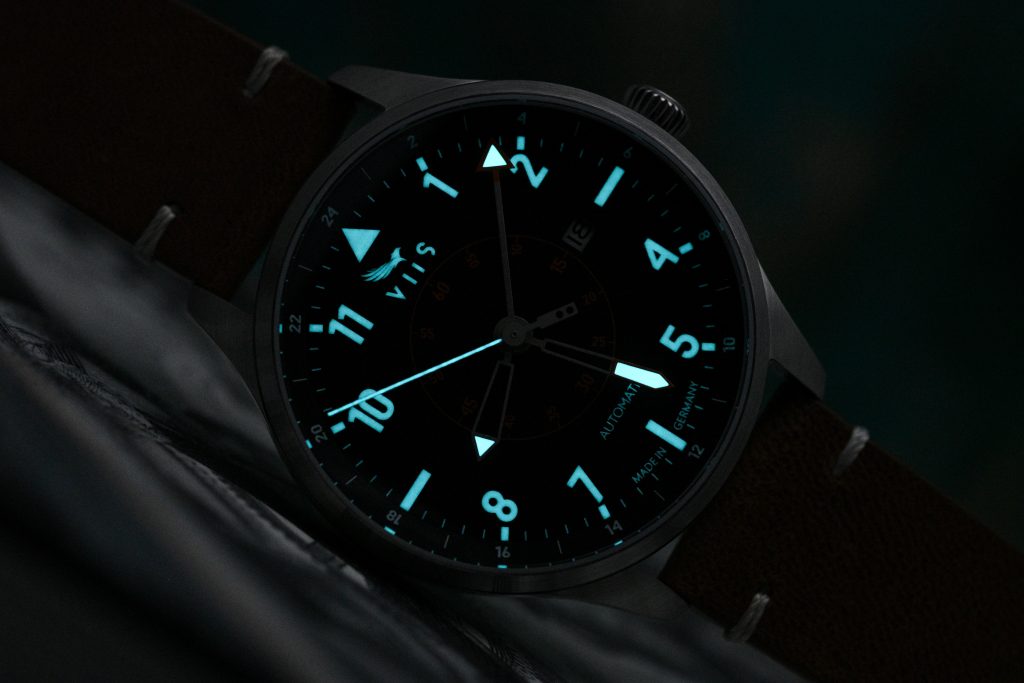
Performance follows a fairly typical hierarchy. The large numerals and their rectangular hour markers are lumed, but the application style and limited surface area mean there simply isn’t a huge volume of lume material there, so those elements tend to fade sooner than the hands.
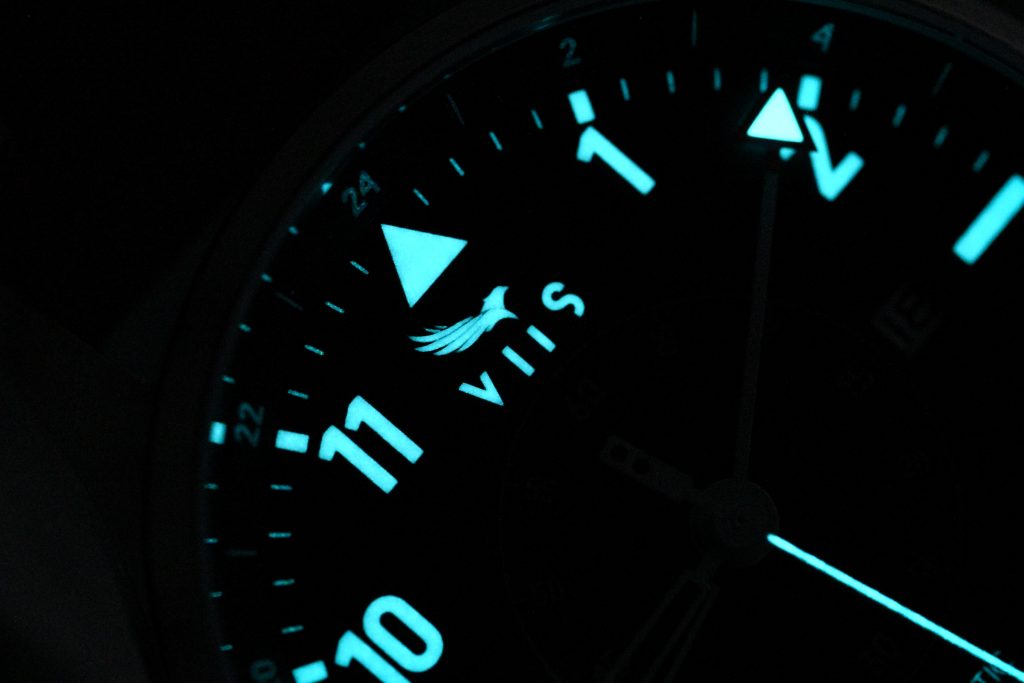
The hands carry most of the nighttime legibility: the hour, minute, and GMT hands have large lume-filled sections that glow brighter and last longer, while the seconds hand is fully lumed along its length and holds up reasonably well too.
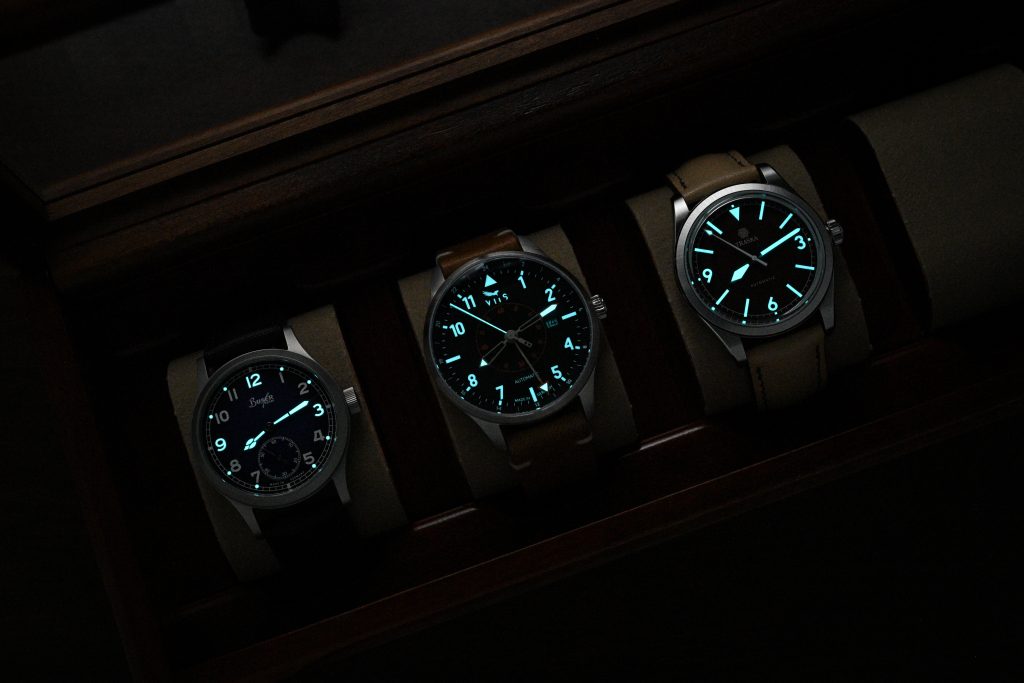
Overall, this isn’t “flashlight” levels of lume with exceptional brightness and longevity, but it remains legible well into the night. Even once the numerals start to drop off, reading the time is still straightforward because the hands stay clearly defined. Against the Buser Freres GSTP 38 (which has a similar lume layout) and a Traska Summiteer 38 (which is in a similar price range, with stronger lume blocks), the VIIS isn’t the outright winner, but it holds up well.
Movement
The Velebit is powered by the Miyota 9075, a true GMT caliber from the Citizen Group and one of the most consequential movement releases the micro-brand space has seen in the last few years. It sits within Miyota’s 9 series of automatic calibers, generally known for being robust and relatively slim, which makes it an easy fit for watches that want genuine travel functionality without ballooning in thickness or price. And importantly, it’s a true GMT: you get an independently jumping local hour hand, so you can move the hour hand in one-hour increments without affecting the minutes or the GMT/reference time.
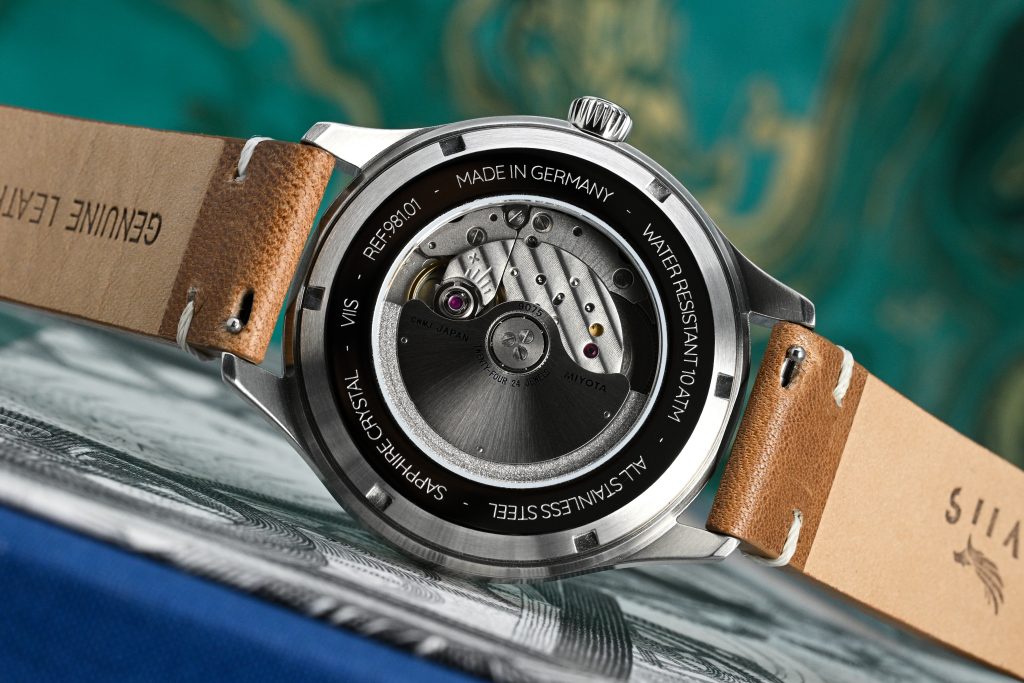
What’s interesting here is that while the 9075 has become almost a default “upgrade move” for micro-brands, the flieger world hasn’t embraced it to the same degree. Part of that is probably tradition: pilot watches often lean Swiss or German by default, and part of it is simply that true GMT options are limited if you want to stay off-the-shelf. The most visible alternative in the broader market is the Kenissi true GMT architecture, but that’s not a movement you can just order as a small brand, and when you see it deployed it tends to be in watches living in the $4k–$6k range (think certain Fortis and Tudor references).
So the result is that many of the more established German flieger brands that do offer GMTs often do so with caller-style movements. Laco’s Pilot Frankfurt GMT being a good example, and Hanhart has also taken that more conventional route. Against that landscape, VIIS’ willingness to spec a Japanese true GMT is actually a meaningful differentiator, and in my view, an advantage: you get functionality that matters, without forcing the watch into a very different price bracket.
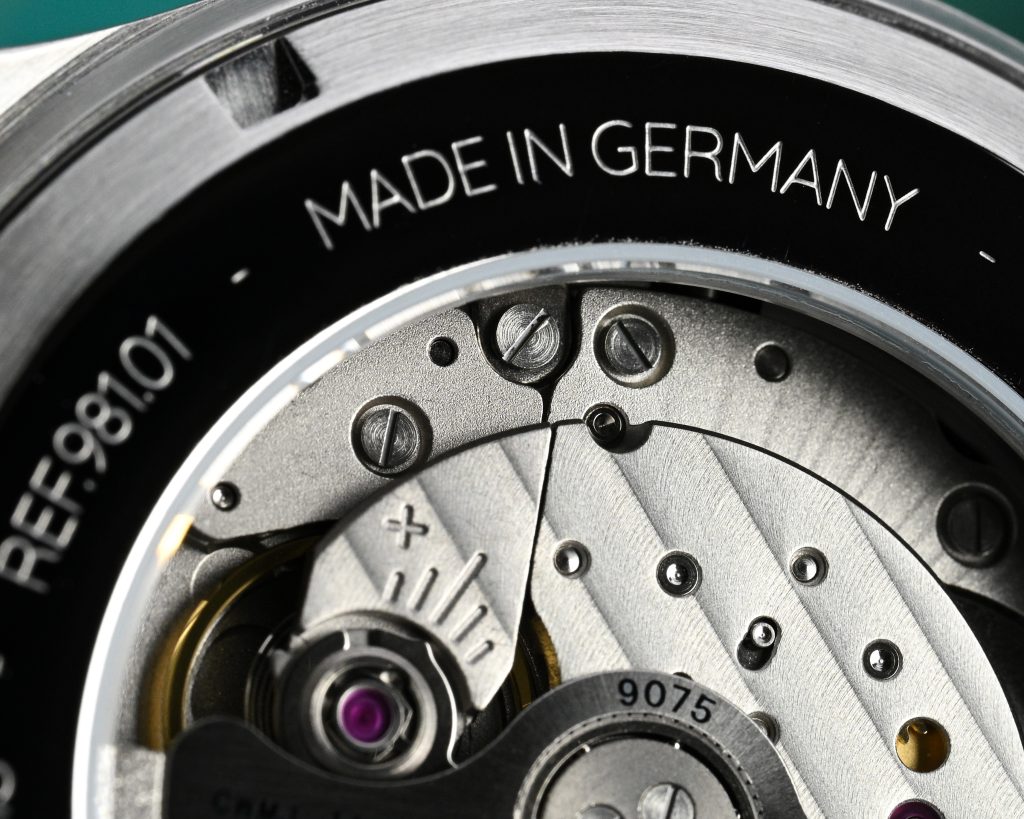
On paper, Miyota rates the 9075 at -10 to +30 seconds per day, with a 42-hour power reserve, running at 28,800 vph (4 Hz), and it includes hacking seconds. On this unit, I measured it at +8 spd, which is good and frankly about what you typically see from a movement in this category.
On The Wrist
In terms of sizing, this Flieger GMT doesn’t stray far from the traditional mold. Fliegers have historically been large watches: some of the original examples were 55mm and intended to be worn over a pilot’s jacket. But over time they’ve come down in size to match modern preferences, and even brands like IWC and Laco have embraced smaller flieger designs. The Velebit lands in that modern middle ground: not huge by historical standards, but still meaningfully large by everyday-wear standards.
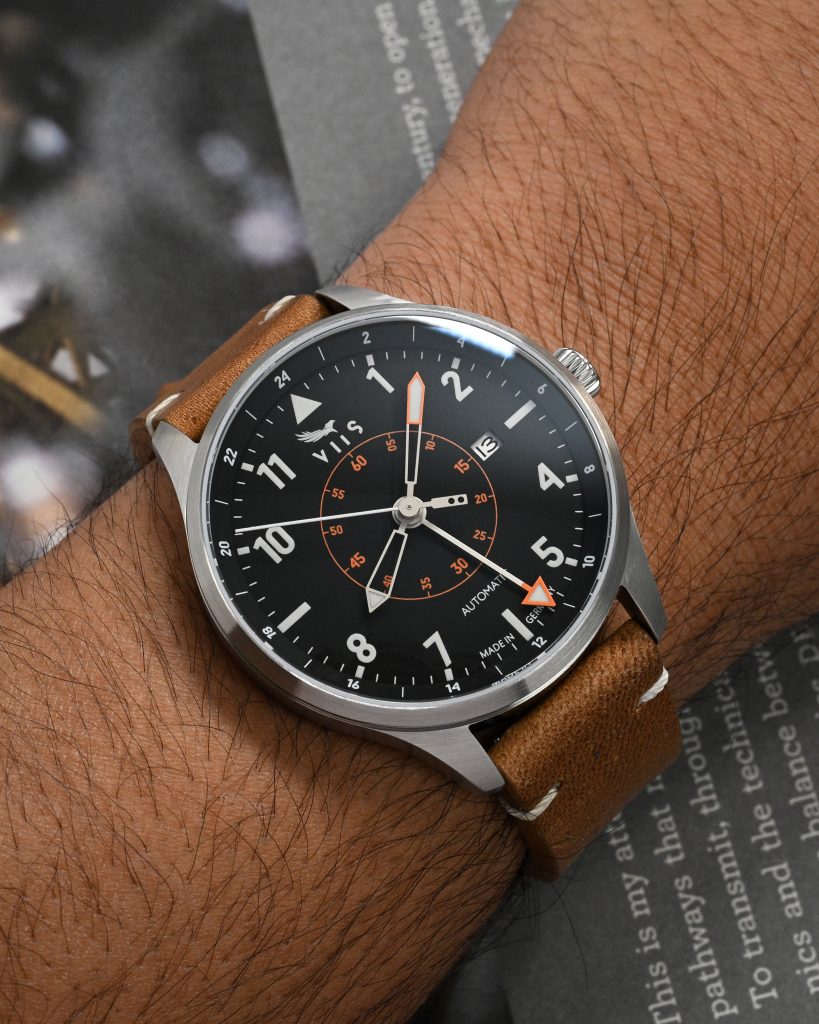
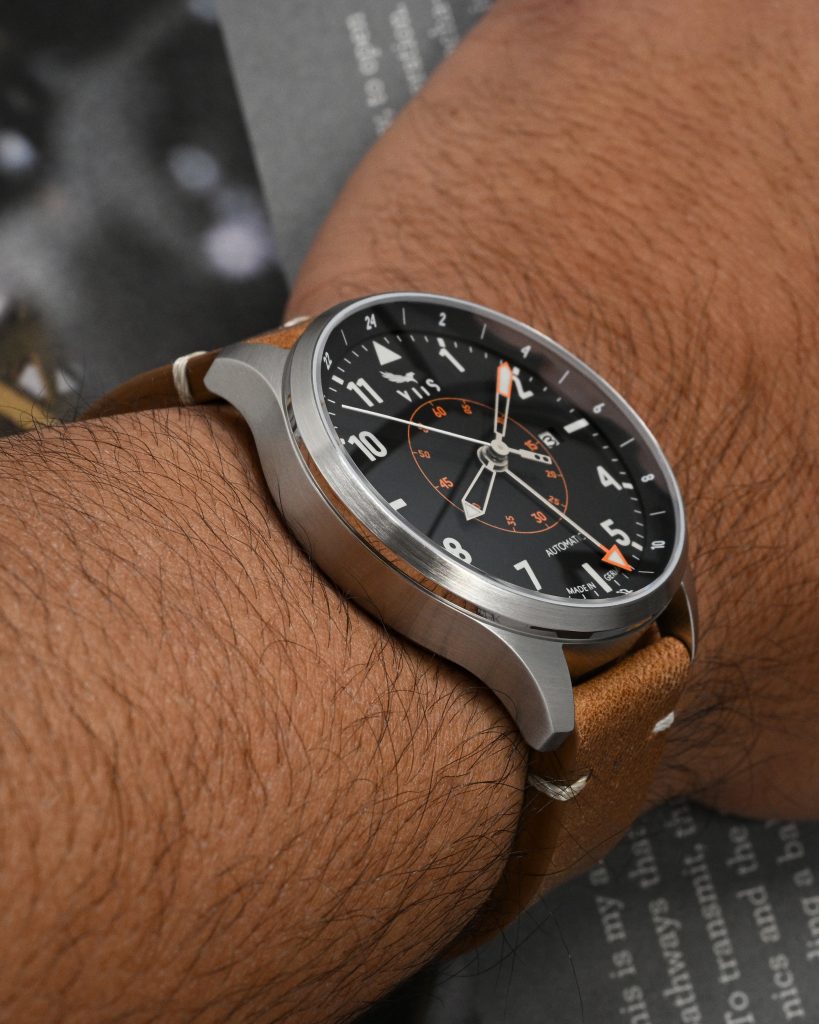
The watch measures just under 42mm in diameter with a 48.6mm lug-to-lug, and the narrow bezel makes it wear visually larger than the numbers suggest. On my 6.75″ wrist, it fits without overhang, but it still looks like a big watch, very much in line with flieger design principles, though I can see why some buyers might prefer smaller alternatives. Thickness is 13mm, and a lot of that comes from the curved crystal; I would’ve preferred a flat crystal, but it isn’t a deal breaker.
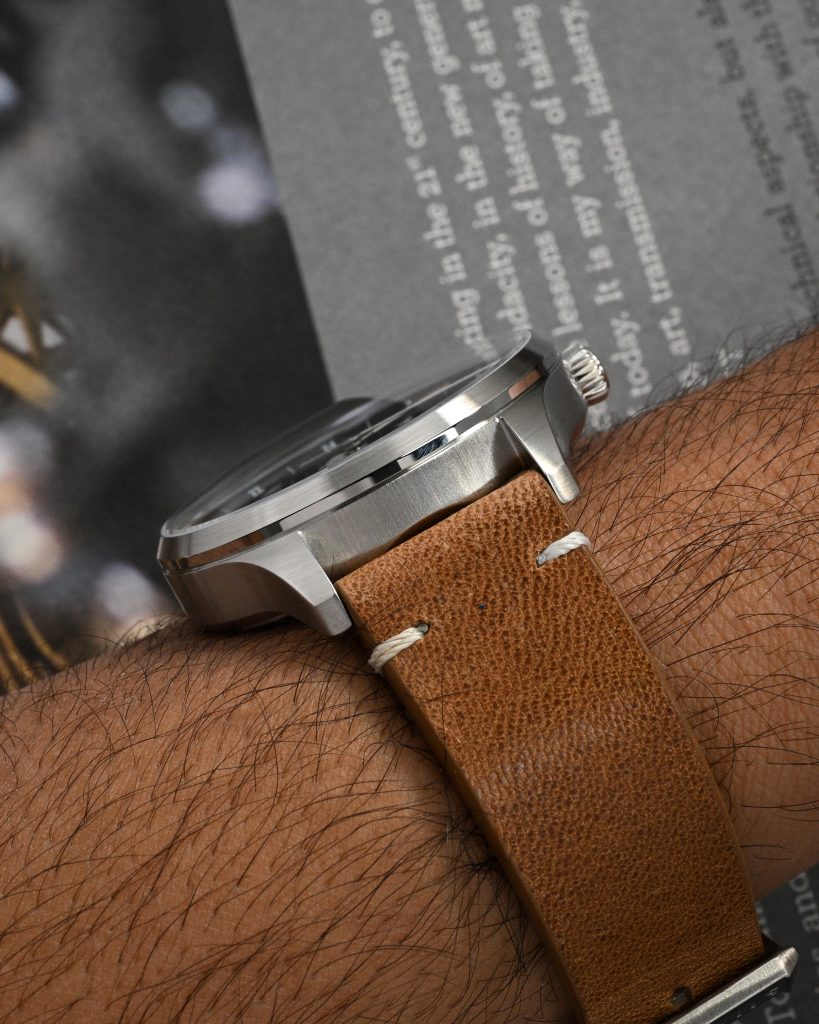
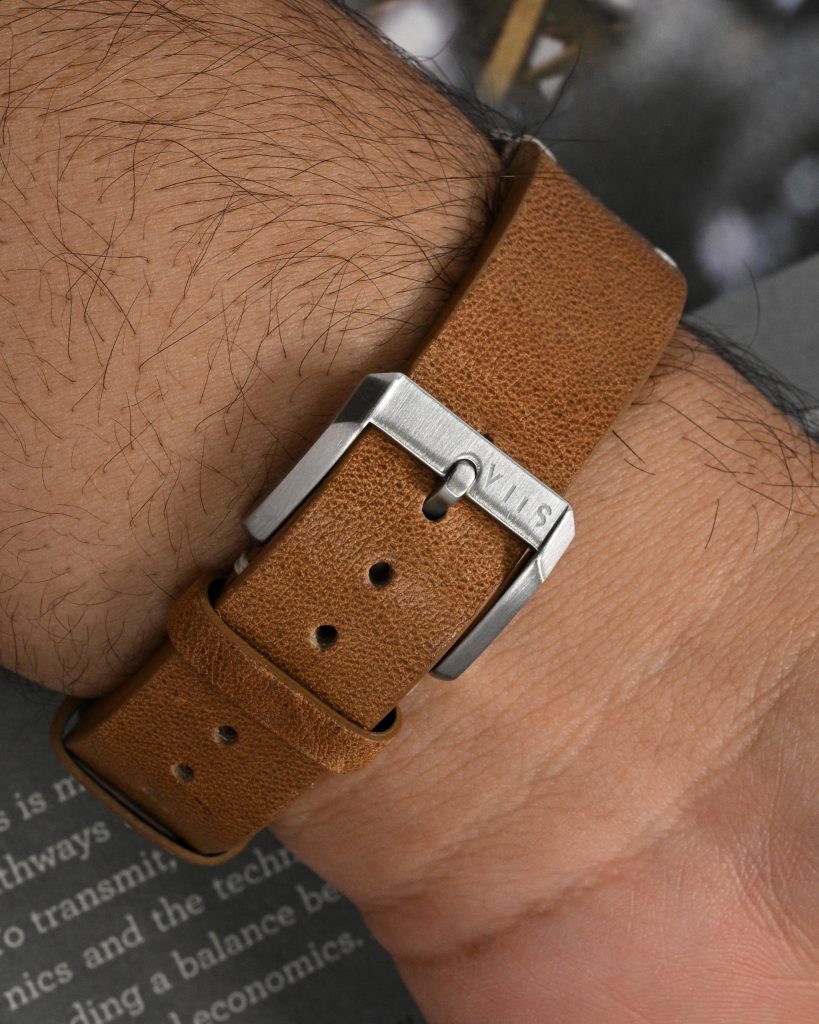
The included leather strap is good quality and broke in nicely. Weight is 68g head-only and 82g with strap and buckle, and I appreciate that VIIS opted for a more modern, non-generic buckle that feels intentionally designed rather than pulled from a parts catalog.
Wrapping Up
Overall, the VIIS Flieger GMT 42 is a genuinely interesting release. It’s a German-built flieger concept paired with a Japanese true GMT movement, and that combination alone makes it stand out in a category that often defaults to familiar formulas. The watch retains plenty of classic flieger DNA, but it also takes some creative liberties on the dial and leans into more modern choices: most obviously with a 42mm case that nods to contemporary preferences without chasing the current “Goldilocks” 39-40mm sweet spot.
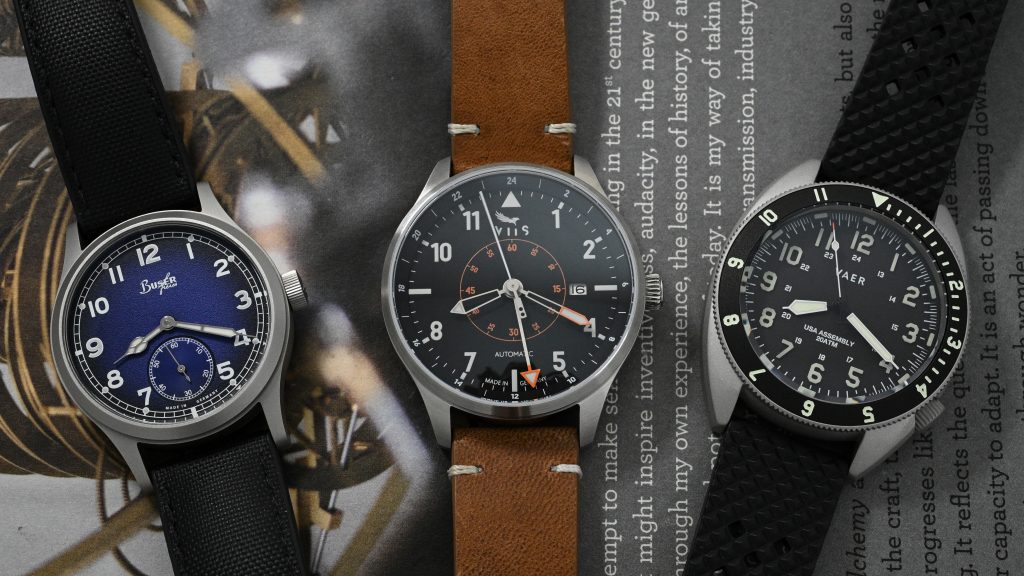
It also brings some tangible spec advantages to the table. The curved crystal and screw-down case-back give it a more modern, slightly more robust personality, and the 100m water resistance is a notable achievement in this space, especially when you consider that a brand like Laco typically offers half that on their fliegers. Add in the generous and engaging lume design (even if it isn’t the absolute best performer), and you end up with a watch that feels respectful of the flieger design ethos without being just another design reissue.
So if your goal is a flieger with a “true” GMT, good usability upgrades, and enough of the original pilot-watch template to still feel authentic, without being a pure vintage reissue, the Flieger GMT 42 makes a strong, coherent case for itself.